The short answer: with fixed odds, you lock in a price with a bookmaker when you bet. With the tote, your money goes into a pool with everyone else's, a commission comes off the top, and the dividend isn't known until betting closes. Fixed odds give you certainty, apart from scratching deductions. The tote can pay more or less than the price you saw, and in a small pool your own bet can move it.
Neither one is better every time. Here's how each one works in numbers, so you know what you're signing up for.
General information only, not advice. Chances are you're about to lose. Most punters lose more than they win. 18+ only. Read your operator's rules before you bet.
Key takeaways
Fixed odds: the price is locked at the time of the bet. Deductions are the main thing that can cut it.
Tote: the dividend is the pool, minus commission, divided by the money on the winner.
The commission is the cost of the tote: 14.5% on win pools in the new national pool, and up to 23% on First Four.
Small pools swing: a single bet can move the dividend.
Scratchings work differently: fixed odds use deductions, while the tote refunds money on the scratched runner and reshares the pool.
Fixed odds: you take a price
The bookmaker sets a price and you take it or leave it. Prices move with weight of money, late mail and scratchings. Once your bet is accepted, that price is yours. $10 at $3.00 returns $30, including your stake.
The cost is built into the price. Add up the implied chances of every runner and the total comes to more than 100%. That extra is the bookmaker's margin, or overround. Our guide to horse racing betting strategies works through an example.
Two things punters forget. A bookmaker can limit how much it lets you bet or turn a bet down, while the tote has no maximum (a big bet just moves your own dividend). And getting the best fixed price is your edge, so check the live odds and market movers before you lock anything in.
Tote: you join a pool
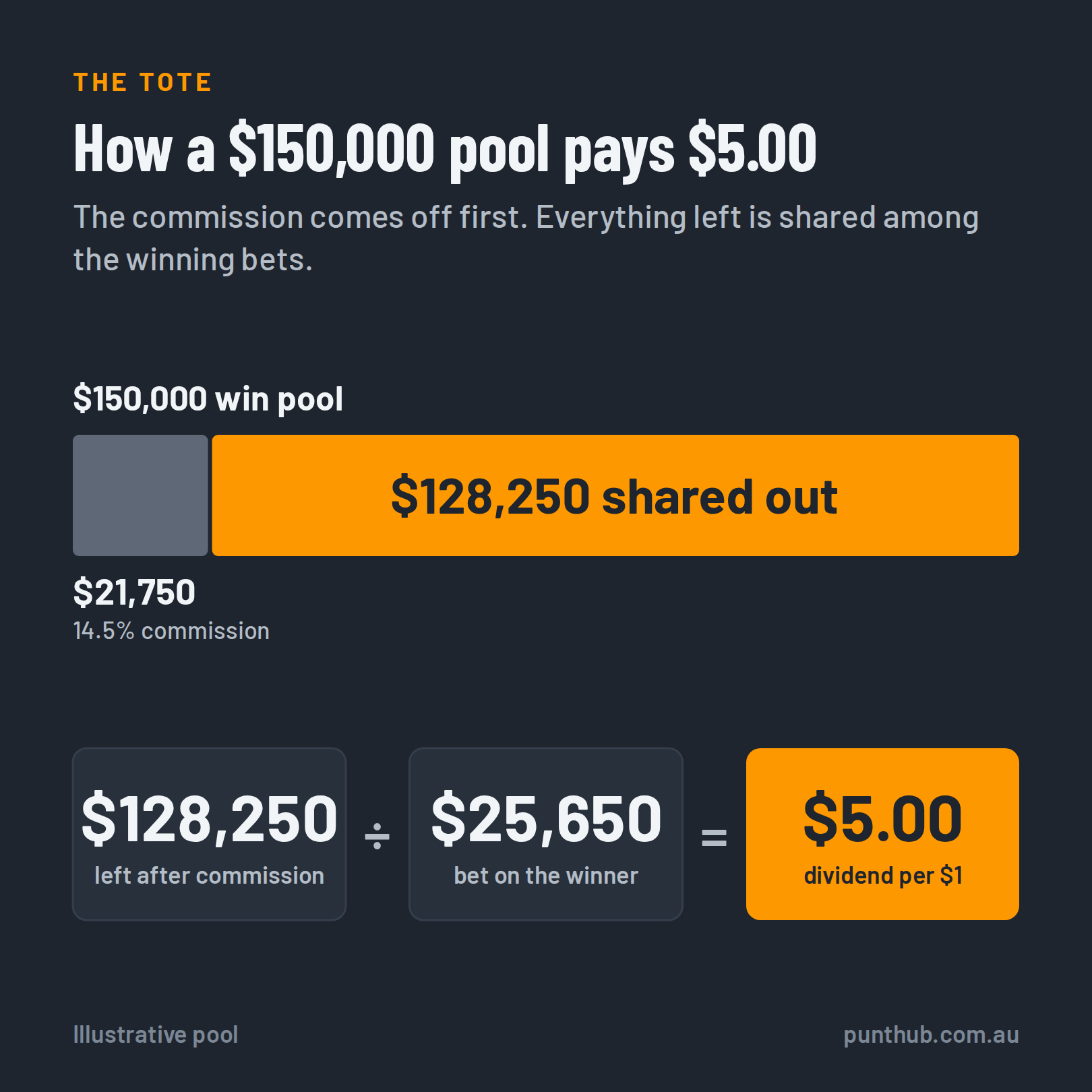
Every tote bet of the same type on the same race goes into one pool: win bets with win bets, trifectas with trifectas. When betting closes, the operator takes its commission and shares out the rest among the winning bets. The dividend is quoted as the return per $1, including your stake, and it's rounded down to the nearest 5 cents.
Worked example: a $150,000 win pool loses 14.5% in commission ($21,750), leaving $128,250. If $25,650 was bet on the winner, the dividend is $128,250 ÷ $25,650 = $5.00.
What the tote takes
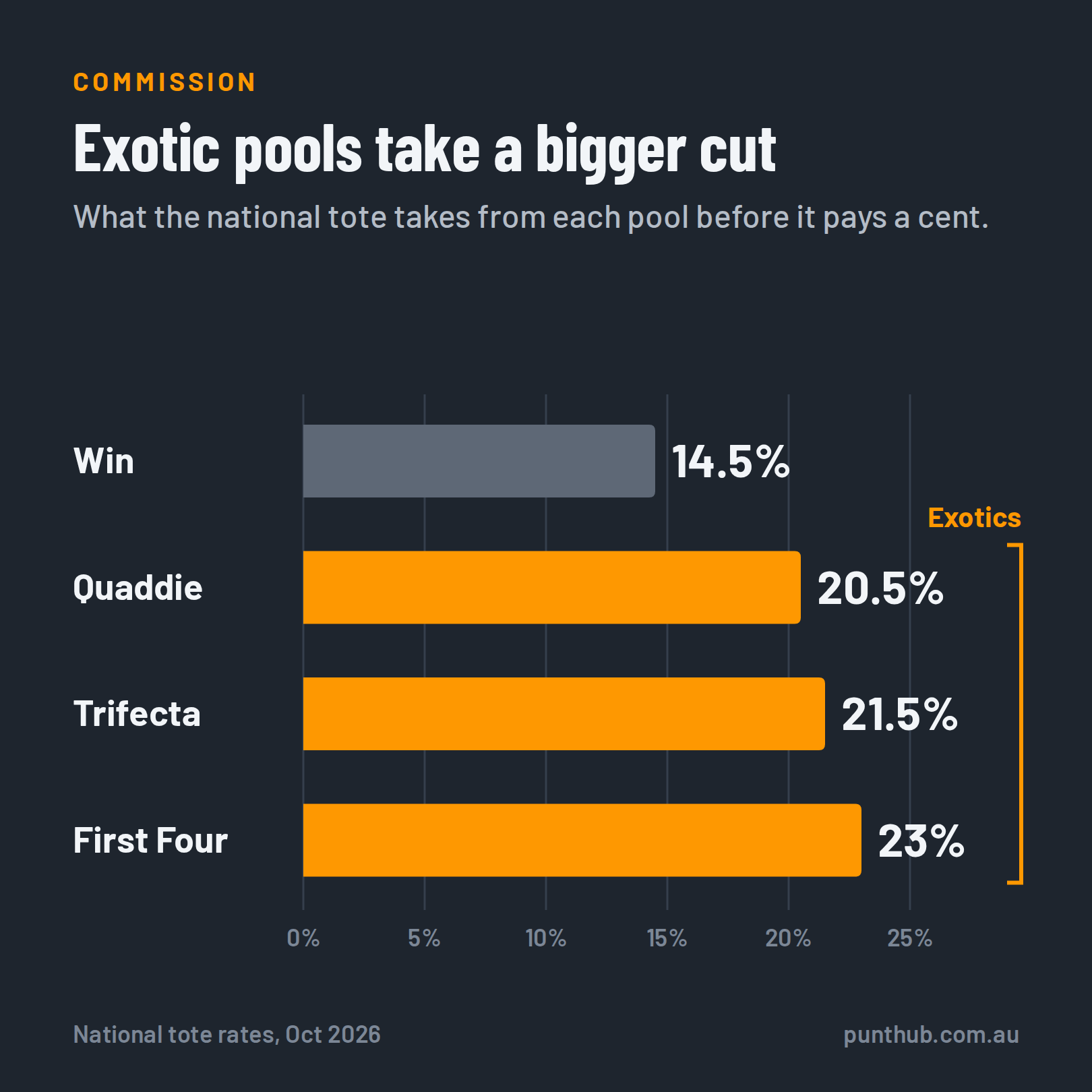
Commission in the national pool, by bet type:
Win: 14.5%
Quaddie: 20.5%
Trifecta: 21.5%
First Four: 23%
The quaddie, trifecta and First Four rates each went up half a point for punters who used to bet into the old NSW and Victorian pools. Exotic pools cost more, so the bigger the dream payout, the bigger the cut.
The national pool changed things
On 2 October 2026, Australia's three main state-based tote pools were merged into one national pool, called One Pool, covering every domestic meeting across all three codes and all pool types. International meetings are due to follow. Punters across the country now see one dividend instead of three. Bigger pools should mean steadier dividends, especially in midweek and greyhound races where some pools used to hold only a few hundred dollars.
Why your own bet can move the dividend
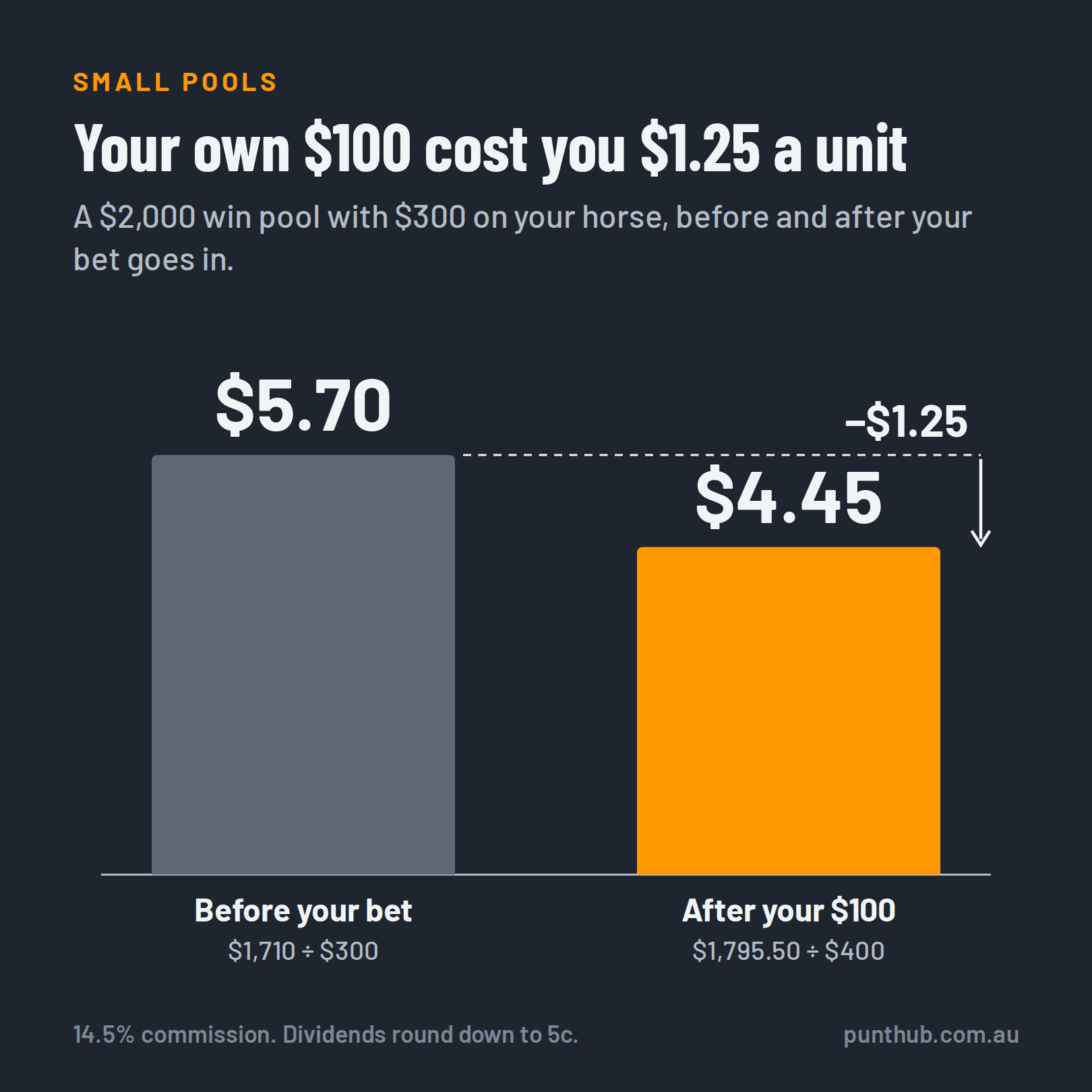
In a big Saturday pool, your $100 makes no real difference. In a small one, it does.
Worked example: a $2,000 win pool leaves $1,710 after commission. If $300 is on your horse, it shows $5.70. Add your $100 and the pool becomes $2,100, leaving $1,795.50 after commission, but there's now $400 on your horse. The dividend falls to $4.45 once it's rounded down. Your own bet cost you $1.25 per unit before the race even started.
How tote place dividends work
Fields of eight or more pay three places, fields of five to seven pay two, and races with fewer than five starters have no place betting. After commission, the place pool is split into an equal share for each placing. Each share is then divided by the money bet on that placegetter. That's why an outsider running third can pay a bigger place dividend than the favourite that wins. The outsider's share is divided among far fewer bets.
Head to head
Price set by: fixed odds, the bookmaker, locked when you bet. Tote, the pool, final when betting closes.
Cost to you: fixed odds, the margin built into the prices. Tote, the commission taken from the pool.
Your runner is scratched: fixed odds, refunded after the final field (not on all-in bets). Tote, refunded.
Another runner is scratched: fixed odds, deductions may apply. Tote, no deductions; the pool is reshared.
Big bets: fixed odds, can be limited or refused. Tote, accepted, but they move the dividend.
Best for: fixed odds, certainty and grabbing a price before it shortens. Tote, exotics and runners the pool may underrate.
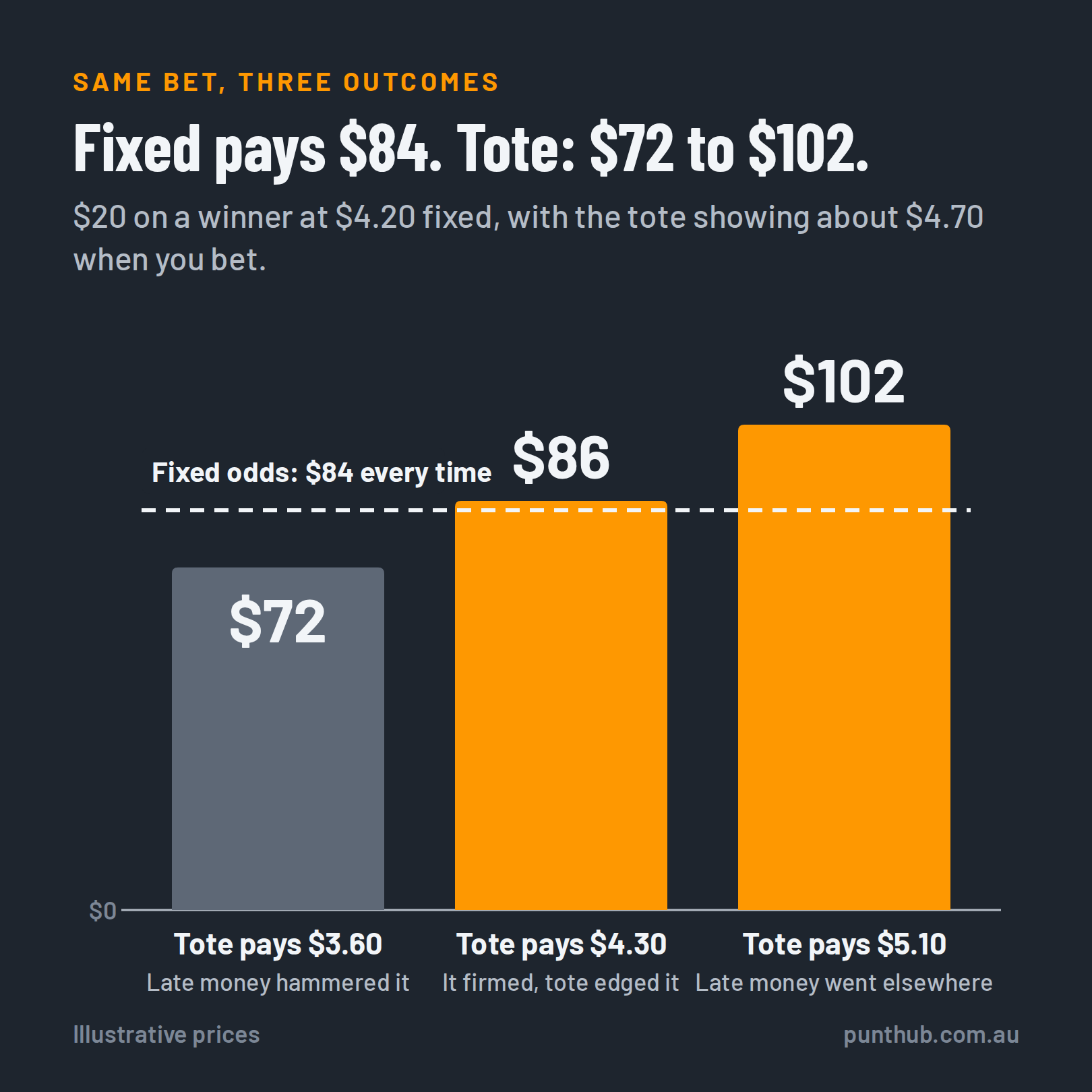
Same bet, three outcomes
You put $20 on a horse at $4.20 fixed. The tote shows about $4.70 at the time. If it wins, here's where the tote could finish:
Tote pays $3.60: $72 back, against $84 fixed. Late money hammered your horse.
Tote pays $4.30: $86 back, against $84 fixed. It firmed a bit, but the tote still edged it.
Tote pays $5.10: $102 back, against $84 fixed. Late money went elsewhere.
The fixed bet pays $84 every time, as long as nothing else is scratched. The tote ranged from $72 to $102. That's the trade: certainty, or a pool that can go either way.
Scratchings, refunds and deductions
Fixed odds
Before the final field: early and futures bets are usually all-in. If your horse doesn't run, you lose your stake.
After the final field: if your horse is scratched, you get your stake back.
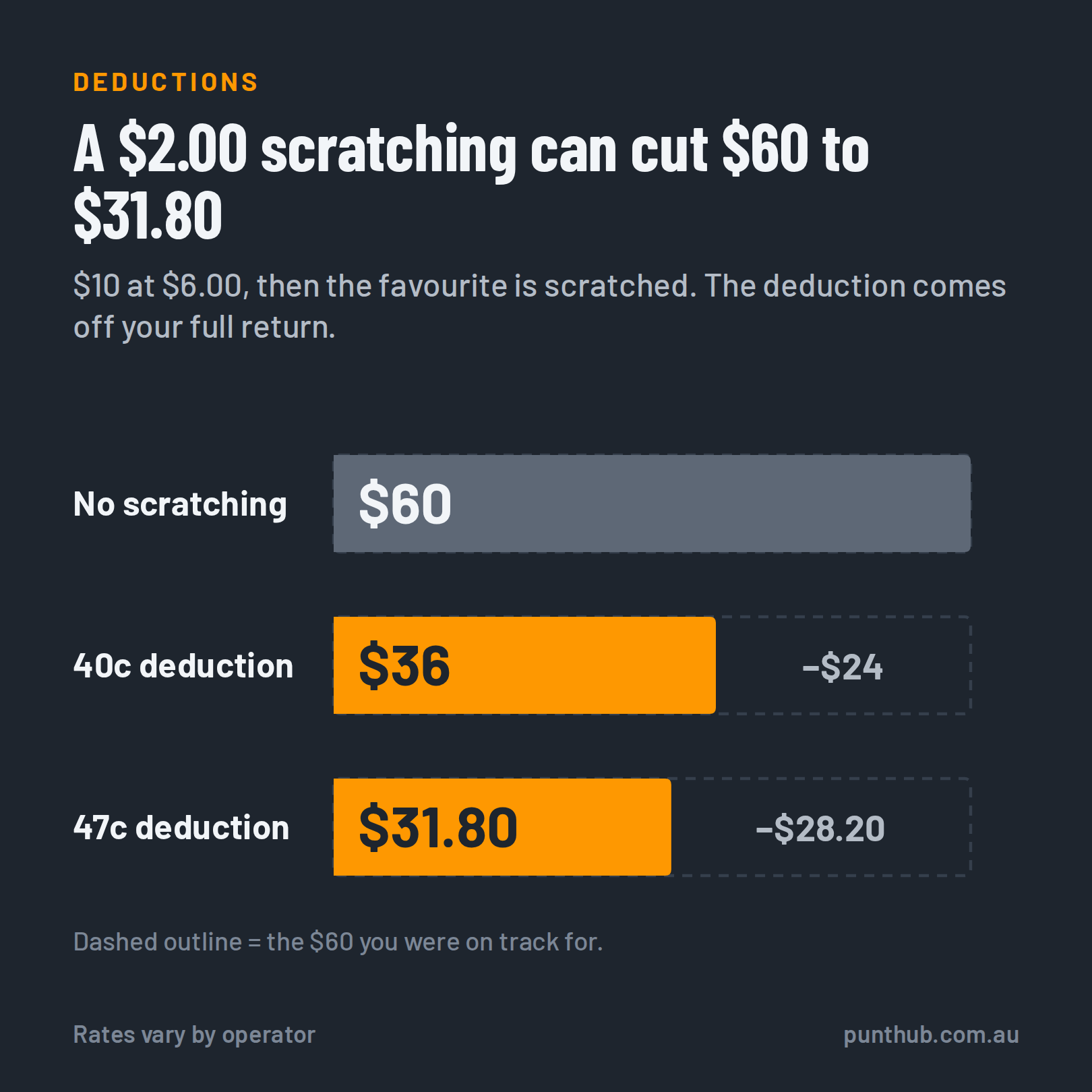
Another runner scratched: a deduction can come off winning bets placed before the scratching. The shorter the scratched horse's price, the bigger the deduction. Place bets get a smaller deduction than win bets. Each operator publishes its own scale.
Worked example: you have $10 on a horse at $6.00, a $60 return. The $2.00 favourite is scratched after you bet. Depending on the operator, a scratched $2.00 chance means a win deduction of around 40 to 47 cents in the dollar. In Australia the deduction comes off your full return, stake included, so you collect between $31.80 and $36 instead of $60. Check your operator's scale before you bet early.
Tote
Money on the scratched runner is refunded and taken out of the pool.
There are no deductions. The dividend is worked out from what's left, so it can rise or fall depending on where the refunded money goes next.
The number of places paid is set when scratchings close. A late scratching that takes a field from eight to seven still pays three places. If the field drops below five starters, place bets are refunded.
Multi-race bets are different: in quaddies and doubles, a scratched runner is usually replaced by a substitute under the tote rules rather than refunded.
Tote-style bets with a bookmaker
Many bookmakers offer bets that settle on the tote dividend without your money ever going into the pool. The bookmaker pays you out based on the declared dividend. With one national dividend now instead of three, "best of the totes" products have nothing left to compare, so several have been renamed or replaced, for example with bets that pay the better of the tote dividend or starting price. Check how any tote-style product you use now settles.
Starting price (SP) bets are different again. They settle on the official starting price, which comes from the on-course bookmakers' final prices, not from the tote.
Which one should you use?
You want to know your return: fixed odds.
You think a horse will shorten: take the fixed price before it goes.
You're betting exotics: trifectas, First Fours and quaddies mostly run as tote pools, so the commission is part of the deal.
You're betting a big amount into a small pool: expect to move the dividend yourself.
Before you open an account, compare Australia's bookmakers on prices, payout speed and rules.
Responsible betting
Neither fixed odds nor the tote changes the basic maths: over time, the margin and the commission favour the operator. Bet only what you can afford to lose. Set deposit limits while you're calm, and never chase losses. BetStop lets you self-exclude from every licensed Australian online wagering operator. Free, confidential help is on 1800 858 858 or at gamblinghelponline.org.au, and our responsible gambling resources have more.
Frequently asked questions
What's the main difference between fixed odds and tote betting?
Fixed odds lock in your price when you bet, subject to scratching deductions. The tote pools everyone's money, takes a commission and shares the rest among the winners, so the final dividend isn't known until betting closes.
How is a tote dividend calculated?
Take the pool, subtract the commission, then divide by the total bet on the winner. A $150,000 win pool at 14.5% commission leaves $128,250. With $25,650 on the winner, that's a $5.00 dividend.
Are tote prices final when I bet?
No. They're estimates that change with every bet until betting closes.
Can the tote pay more than fixed odds?
Yes. It can when the winner attracts less money than expected late in betting. It can also pay less.
Do deductions apply on the tote?
No. Money on a scratched runner is refunded and the dividend is calculated from the remaining pool. Deductions are a fixed-odds rule.
Does a late scratching change the places paid on the tote?
No. The number of places is set when scratchings close, so a field that drops from eight to seven still pays three places. If it drops below five starters, place bets are refunded.
What is One Pool?
It's Australia's national tote pool, launched on 2 October 2026. It merged the country's three main tote pools, so punters now see one dividend instead of three.
Which is better for beginners?
Fixed odds are easier to understand because you know your return when you bet. The tote suits exotics and punters who are comfortable with a dividend that can move.
More answers in our help and FAQ.
Disclaimer: General information only, not financial or betting advice. Examples use illustrative figures. Commission rates, deductions and settlement rules vary by operator and can change. Punt Hub is not a bookmaker. Chances are you're about to lose. Free, confidential support: 1800 858 858.
18+ only. Gamble responsibly.