The short answer: no strategy guarantees a profit on racing. Every fixed-odds price has a margin built in, and every tote pool has a commission taken out before anyone's paid. The few operations that beat the market spend millions on data and modelling, and still lose plenty of races. Your mate's system doesn't. Neither does the $: 99 PDF.
What a strategy can do is stop you overpaying, betting on things you don't understand, and making calls you'll regret. Here's the maths behind the prices, how the bets pay, and how to stake through a bad run. Entertainment first. Always.
General information only, not advice. Every bet is a risk and tips on Punt Hub are opinion, not a promise. 18+ only. Check current odds and terms before you bet.
Key takeaways
Implied probability is 1 ÷ the decimal odds. $: 4.00 says 25%.
Every market adds up to more than 100%. The extra is the margin you pay.
Value means the price is longer than the real chance. It has nothing to do with being the favourite.
Losing runs are maths, not bad luck.
Variance will humble you
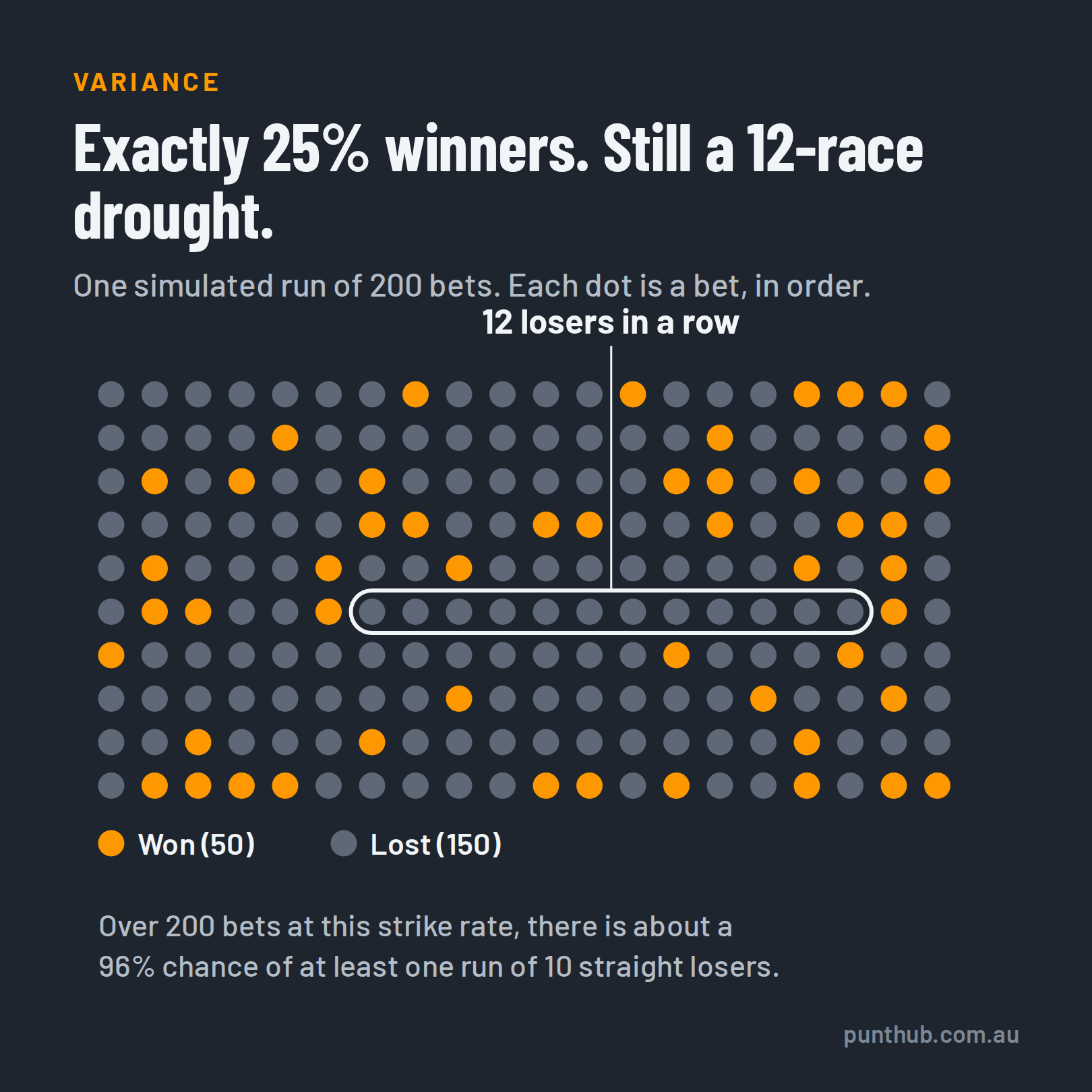
You can make the right bet and lose, and a dumb bet can still win. That swing is variance, and it's bigger than most punters think.
Say every horse you back genuinely wins 25% of the time. Across 200 bets, the chance of hitting at least one run of 10 straight losers is about 96%. A 15-race losing streak turns up roughly half the time.
So bet money you can afford to lose. Not rent money. Treat it as a leisure expense, like a night out.
Know your bet types
Win, place and each-way
Win: your runner finishes first.
Place: top three with eight or more starters, top two with five to seven. With four or fewer, place betting usually isn't offered.
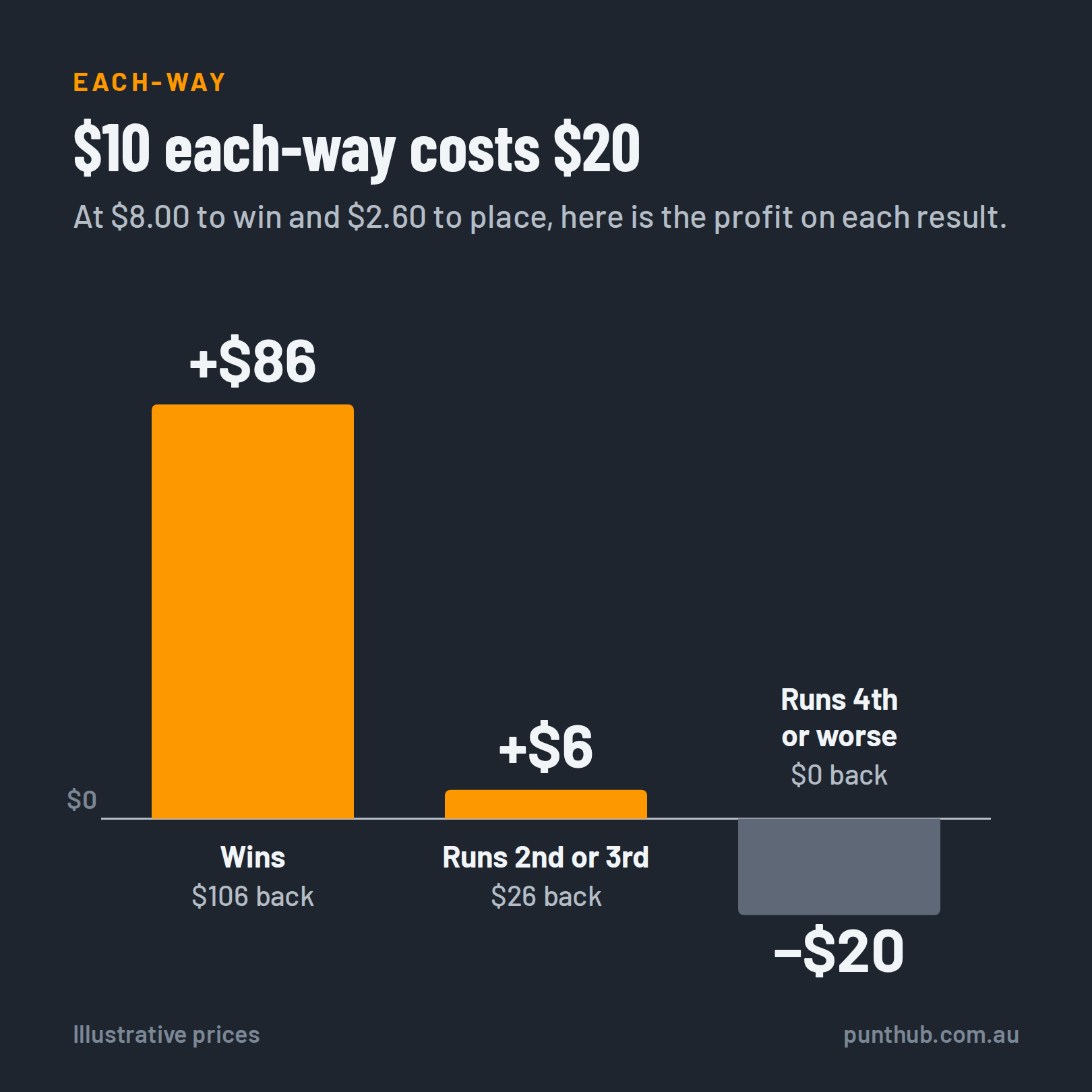
Each-way: a win bet and a place bet for the same stake. $: 10 each-way costs $: 20.
In Australia, the fixed-odds place price is usually set as its own market, not as a fraction of the win price. So check the place price itself.
Worked example: $: 10 each-way at $: 8.00 to win and $: 2.60 to place costs $: 20. If it wins, you get $: 106 back ($: 80 + $: 26). If it only places, you get $: 26 back, which is just $: 6 profit. If it runs fourth or worse, you lose $: 20. A short place price barely covers the losing win half.
Fixed-odds place bets generally keep the place terms that applied when you bet, with deductions if runners are scratched. Rules vary by operator, so read them before the jump.
Exotics and the combination trap
A quinella is the first two in any order and an exacta is the first two in order. A trifecta is the first three in order, and a First Four is the first four in order. Boxing covers every finishing order, which lifts your chance of hitting and multiplies your cost:
Boxed | 3 runners | 4 runners | 5 runners |
|---|---|---|---|
Quinella | 3 | 6 | 10 |
Exacta | 6 | 12 | 20 |
Trifecta | 6 | 24 | 60 |
First Four | n/a | 24 | 120 |
Each number is a separate combination. One horse on top with four underneath for the trifecta is 1 × 4 × 3 = 12 combinations, a fifth of the cost of boxing all five. But if your standout doesn't win, the whole bet loses.
Flexi lets you set your outlay and take a share of the dividend. $: 15 on a $: 60 trifecta box is 25%, so a $: 200 dividend pays you $: 50. It doesn't improve your chances. It just shrinks the payout to match the stake.
Fixed odds vs tote
With fixed odds, you get the price you take, subject to the rules and any deductions. With the tote, everyone's money goes into a pool and a commission of roughly 14% to 25% comes off the top, depending on the bet type. Exotic pools usually carry a higher takeout than win pools. The dividend isn't final until betting closes.
Odds and value: the bit most punters skip
Backing the favourite isn't a strategy. It's a habit. Favourites win plenty of races and can still lose you money if the price is too short.
Implied probability and the overround
Australian odds are decimal and include your stake, so $: 10 at $: 4.00 returns $: 40. To get the implied probability, divide 1 by the odds: $: 5.00 is 20%, $: 4.00 is 25%, $: 2.00 is 50%.
Add up every runner's implied chance and the total comes to more than 100%. The extra is the overround, the margin built into every price. Here's a made-up five-horse race:
Runner | Price | Implied chance | Margin removed | "Fair" price |
|---|---|---|---|---|
A | $: 2.50 | 40.0% | 35.0% | $: 2.85 |
B | $: 4.00 | 25.0% | 21.9% | $: 4.57 |
C | $: 5.00 | 20.0% | 17.5% | $: 5.71 |
D | $: 6.00 | 16.7% | 14.6% | $: 6.85 |
E | $: 8.00 | 12.5% | 10.9% | $: 9.13 |
Total | 114.2% | 100% |
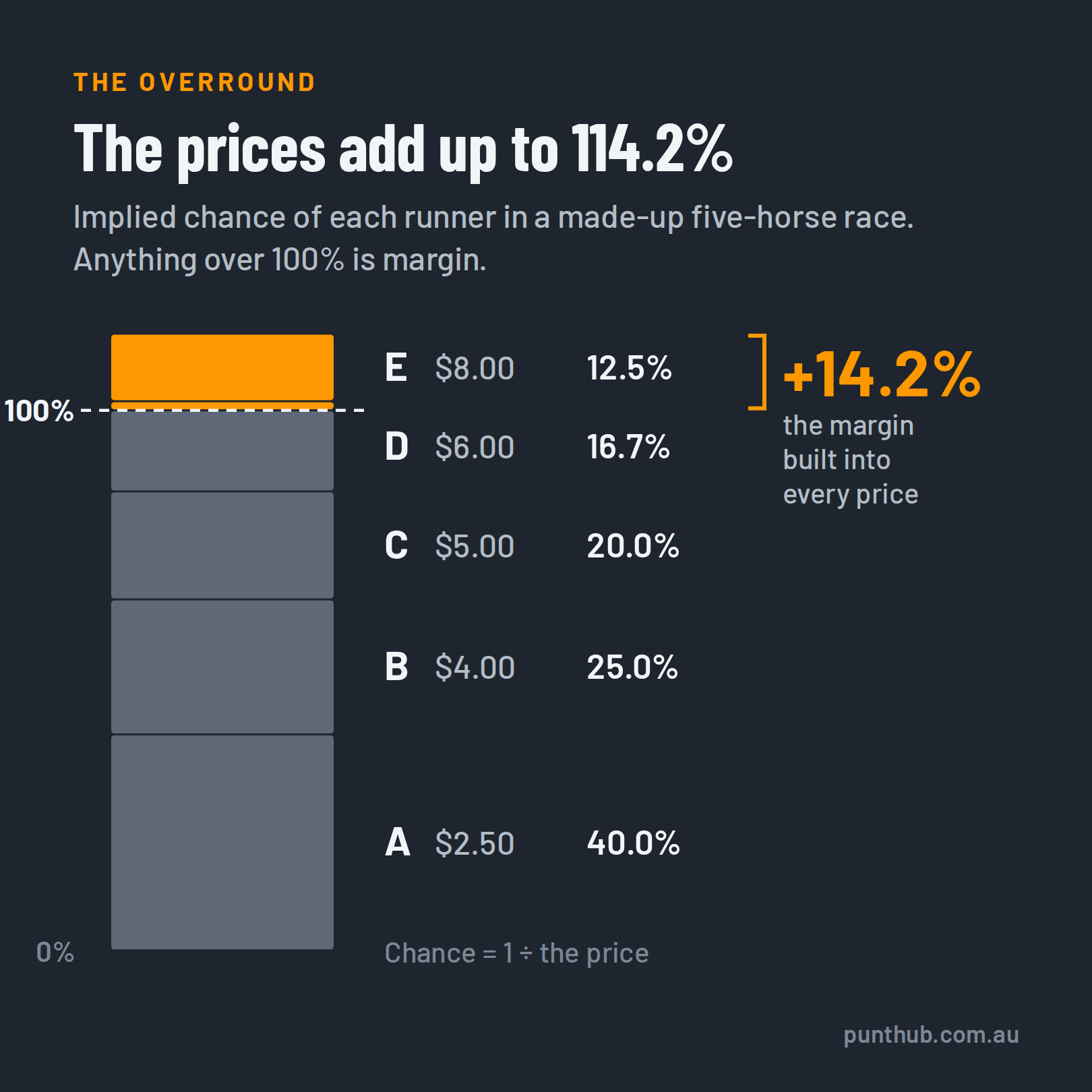
That market is about 14 points over 100%. To strip the margin out, divide each chance by the total (40 ÷ 1.142 = 35.0%), then turn it back into a price (1 ÷ 0.35 = $: 2.85). That's the market's view without the margin, not proof it's right.
Value and expected value
Value is a price longer than the horse's real chance. Expected value (EV) puts a number on it: your estimated chance × the decimal odds, minus 1.
Worked example: you rate a horse at 25%, which makes its fair price $: 4.00.
At $: 5.00, 0.25 × 5 − 1 = +0.25. Over the long run, each $: 10 bet is worth +$: 2.50.
At $: 4.00, the EV is zero. There's no edge.
At $: 3.50, the EV is −0.125, or −$: 1.25 for every $: 10 you bet.
The catch: EV is only as good as your 25%. If your ratings are wrong, the value is imaginary. And a genuine value bet at $: 5.00 still loses three times in four.
Why the best price matters
Say you win exactly 25% of your bets. Take 100 bets of $: 10 at $: 4.00 and you break even. At $: 4.40 the same bets make $: 100, and at $: 3.60 they lose $: 100. Comparing prices is the cheapest edge in racing. When a horse firms or drifts on the live odds and market movers, ask why before you follow the money.
How to read a race
Form and class: look at how it ran, not just where it finished. Did it get checked, run on late, or get cooked in front? Stepping up in class is harder than dropping down.
Track: ratings run from 1 to 10. Firm is 1–2, Good 3–4, Soft 5–7 and Heavy 8–10 (Racing Victoria's scale). They change during the day, so check again before you bet.
Distance and barrier: some horses only fire at certain trips. A wide gate in a short sprint at a tight track can be a death sentence.
Weight and jockey: apprentices can claim up to 3kg off the allotted weight, and the claim reduces as they ride more city winners. A few kilos matters more over a staying trip.
Race shape: a speed map shows who leads, who sits behind them and who has to run home from the back. Plenty of leaders sets it up for the closers. A lone leader can dictate a slow pace. A horse is only as good as the race it gets.
Second opinions: check the community and expert racing tips, then make your own call.
Scratchings and deductions
Bets placed before the final field is declared are usually all-in, so if your horse doesn't run, you lose the stake. After the final field is declared, a scratched horse is refunded. But when another runner is scratched after you've bet at fixed odds, a deduction can come off your payout.
Each operator publishes its own scale, and the shorter the scratched horse's price, the bigger the cut. A late-scratched $: 2.00 favourite typically costs around 40 to 47 cents in the dollar on win bets. Say you've got $: 10 at $: 5.00 for a $: 50 return: a 40-cent deduction on the full return leaves you $: 30. Operators apply deductions differently, so check the rules.
Staking: the boring bit that keeps you in the game
Set your budget for the day or the week before the first race. Cap how much goes on any one race, and stick to it. Before you open an account, compare Australia's bookmakers and check the conditions.
Flat staking: the same amount every bet. It's simple to track and hard to get cocky with.
Percentage staking: a fixed slice of your bank on each bet. At 2% of $: 500, that's $: 10. If the bank drops to $: 400, the stake drops to $: 8. Your bank lasts longer through a cold run.
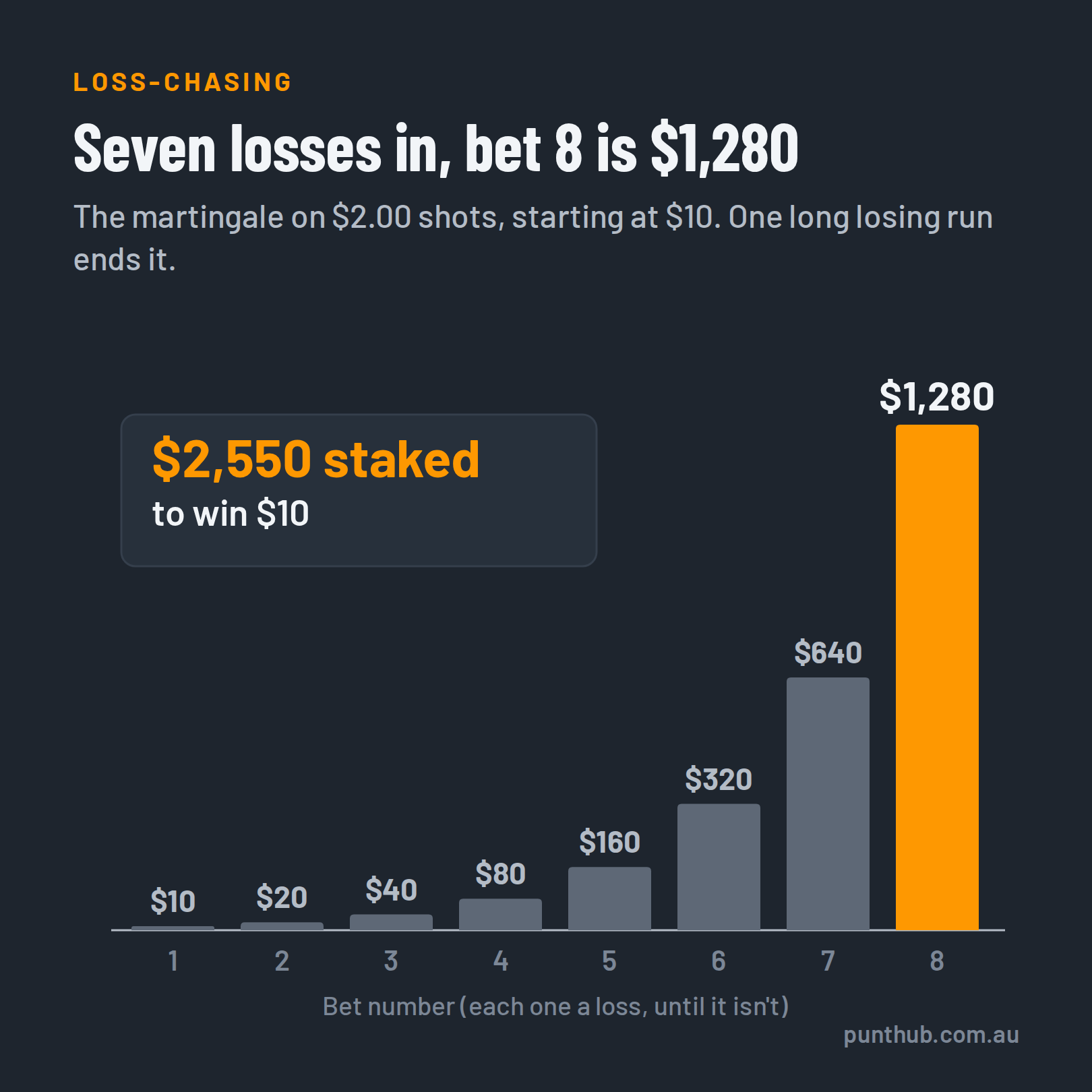
Loss-chasing is panic with a betslip. Under the martingale, where you double your stake after every loss on $: 2.00 shots, a $: 10 start becomes a $: 1,280 eighth bet. By then you've staked $: 2,550 to win $: 10. Long losing runs aren't freak events, and one of them ends the system.
Keep records
Log the price, stake, result and one line on why you bet. Your strike rate is winners ÷ bets. Your return on investment (ROI) is profit ÷ total staked, so $: 1,410 back on $: 1,500 staked is −6%. Hundreds of bets is still a small sample. A better test is whether you're regularly getting a better price than the horse starts at.
The pre-race checklist
Set your budget and limits before you open the app.
Check scratchings, barriers and the track rating.
Ask whether the distance, track, class and likely race shape suit the horse.
Put a number on its chance. Your fair price is 1 ÷ that number.
Compare that with the best price available. No value, no bet.
Pick the simplest bet that fits, and count the combinations before you take an exotic.
Stop at your limit, win or lose.

Responsible gambling: the one that matters most
Racing is meant to be fun. When it stops being fun, stop.
Watch for the signs: betting more than you meant to, hiding it, chasing, or using it to escape a bad day.
Use the limits: set deposit, loss and time limits while you're calm.
No credit: since 11 June 2024, licensed online wagering operators have been banned from accepting credit cards and digital currency.
Self-exclude: BetStop blocks you from every licensed Australian online and phone wagering operator. You choose the period, from three months up to a lifetime.
Get help: free and confidential on 1800 858 858, or see our responsible gambling resources.
18+ Gamble responsibly. If it's no longer fun, free help is one call away: 1800 858 858 or gamblinghelponline.org.au
Frequently asked questions
How does an each-way bet work?
It's two bets, one win and one place, so "$: 10 each-way" costs $: 20. If the horse wins, both pay. If it only places, just the place bet pays, and that may not cover the full $: 20.
What is the overround?
It's the margin in a market. Add up every runner's implied probability, and the amount over 100% is the overround.
What does value mean in betting?
The odds are longer than your estimate of the real chance. If you rate a horse at 25%, anything longer than $: 4.00 is value. Most value bets on longer-priced horses still lose.
How do scratchings affect my bet?
If your horse is scratched after the final field is declared, you're usually refunded. If another runner is scratched after you've bet at fixed odds, a deduction can come off your payout.
Is there a guaranteed betting strategy?
No. Anyone promising one is selling something.
More answers in the Punt Hub FAQ.
Disclaimer: General information only, not financial, betting or investment advice. Examples use illustrative prices. Odds, place terms and deductions vary by operator. No system guarantees a profit. 18+ only. Free, confidential support: 1800 858 858.