
The short answer: in Victoria, every racehorse has a rating, a number that sums up how good the handicappers think it is. In a handicap race, each rating point is worth half a kilo. The better a horse is rated, the more weight it carries, so in theory every runner gets an equal chance. Once you understand how those numbers are set and when they move, a form guide starts telling you a lot more.
This guide explains it in plain English, then shows how to use it when you're picking a bet.
General information only, not advice. Chances are you're about to lose. 18+ only.
Key takeaways
Every horse has a rating. It's set by the Racing Victoria handicappers and reviewed after every run.
One rating point is worth 0.5kg. Ten points between two horses means 5kg between them in a handicap.
Winning costs weight. A win usually adds 3 to 7 rating points, which is 1.5kg to 3.5kg more next time.
Losing doesn't automatically cost points. A horse's rating only drops after genuinely poor runs, and only slowly.
The handicapper rates the past. You're betting on the future. Your edge is spotting horses the numbers haven't caught up with yet.
What handicapping is, in one minute
Picture a running race where the fastest kids have to carry a backpack. The faster they are, the heavier the backpack. Done right, everyone hits the line together.
That's a handicap. Weight slows a horse down, so the handicapper gives the better horses more of it. Jockeys weigh out before the race and weigh in after it, and lead bags in the saddle make up any difference between the jockey's own weight and the weight the horse has been given.
Not every race works this way. Some races give every horse the same weight, or set weights by age and sex only. The handicap races are where ratings matter most, and they make up much of a typical Victorian race meeting.
Step 1: every horse gets a rating
Ratings in Victoria are set by Racing Victoria's handicapping panel. Only their ratings count for Victorian races. Horses coming from interstate or overseas are given a Victorian rating when they're nominated.
A rating is a number on a scale that runs from the 40s up past 120. As a rough guide:
Around 60: a horse in the lower grades, for example a BM58 or BM64 runner.
Around 70 to 80: the middle grades, typical of many provincial and midweek races.
Around 90 and up: good Saturday city handicappers.
105 and up: Group 1 level. An open-age Group 1 winner is rated at least 105.
The handicappers look at the whole of a horse's form, with the most weight on recent runs. For a win, they look at how strong the opposition was, how easily the horse won, the weight it carried, and the margin and time. Every rating is expressed as if the horse were a fully grown four-year-old male. Fillies and mares, and younger horses, get weight allowances on top of that.
You can look up any horse's rating on the Racing Australia website.
Step 2: ratings move after every run
After each start, the handicappers review the run, usually within two to three days. In maiden races, only the winner gets a new rating.
A win: usually 3 to 7 points up (1.5kg to 3.5kg). A Saturday city win counts for more than a country win.
Second or third: usually 1 to 2 points up.
Unplaced: no automatic drop. Ratings aren't cut just because a horse lost.
A genuinely poor run: may drop 1 to 2 points (0.5kg to 1kg). Bigger drops can follow an injury, a long break or a string of poor runs.
A loss with an excuse: no drop. Wrong distance, wrong track, interference, a slow start or being caught wide aren't reasons to lower a rating.
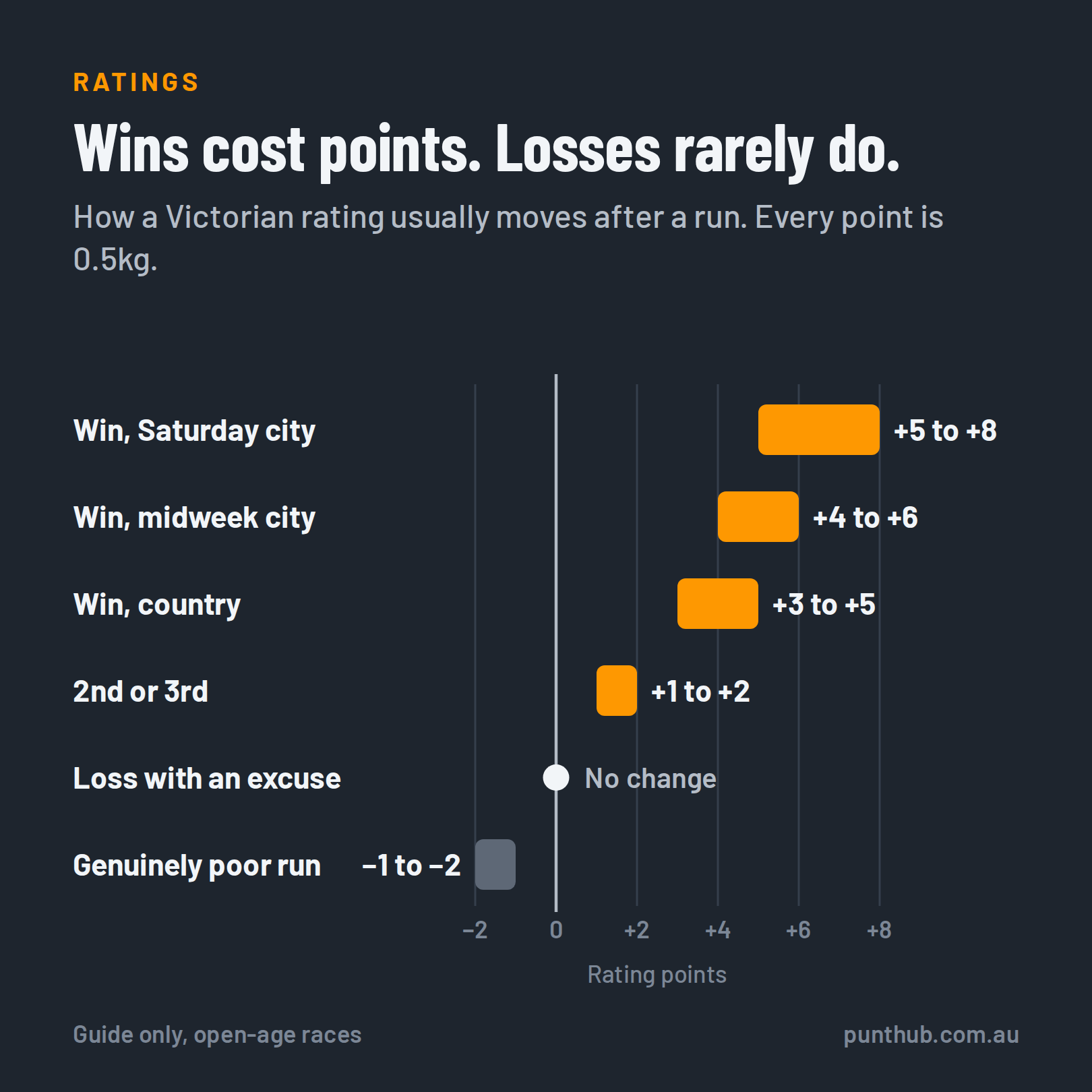
Notice the imbalance. Ratings go up fast after a win and come down slowly after a loss. That matters a lot when you bet, as you'll see below.
Step 3: one point = half a kilo
Most Victorian handicaps are benchmark races, written as BM64, BM78, BM90 and so on. The number is the benchmark rating for that race.
Racing Victoria's own example is a BM90:
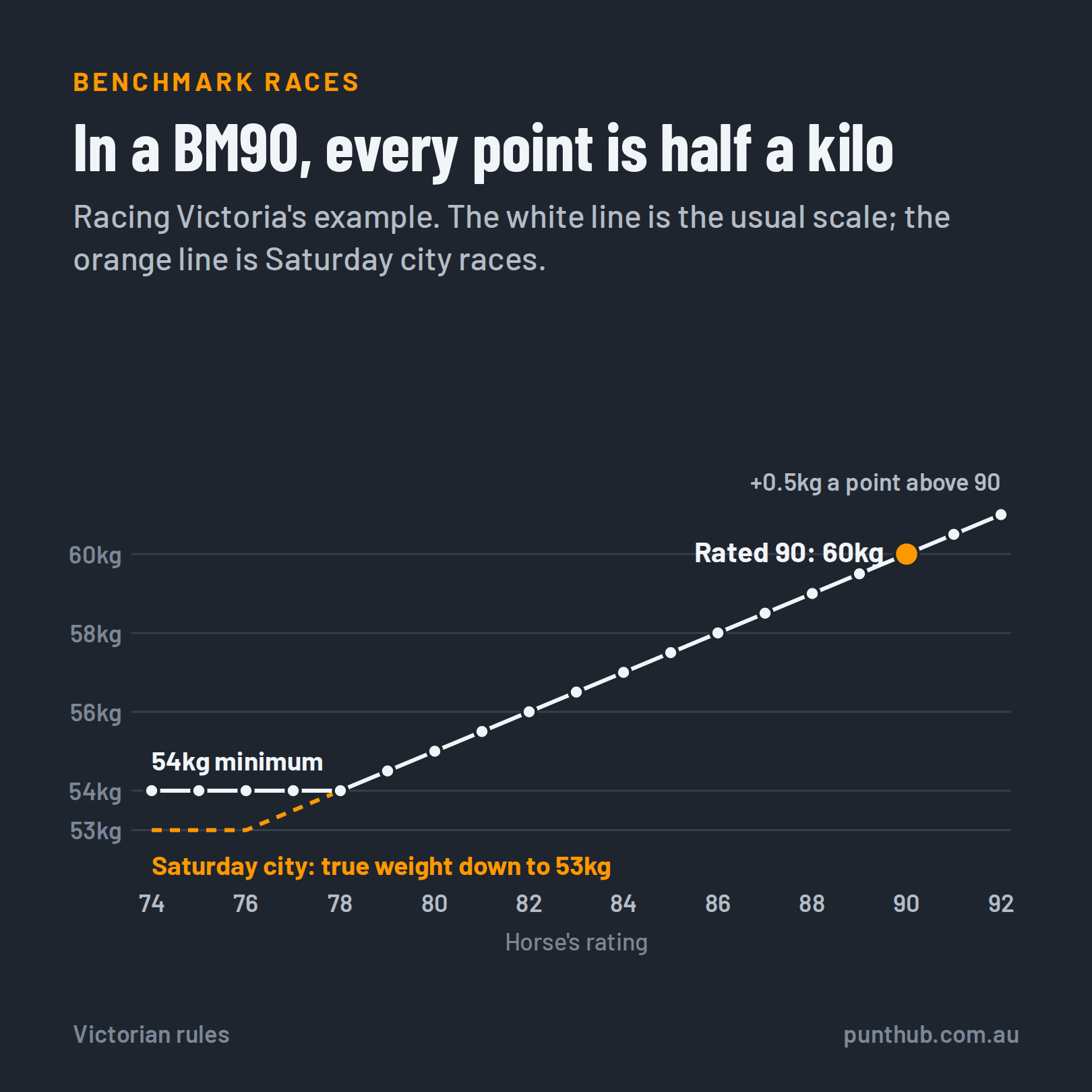
A horse rated 90 carries 60kg.
Every point below 90 takes off 0.5kg, so a horse rated 80 carries 55kg.
Weights stop at the 54kg minimum, which is where a horse rated 78 lands. Anything rated lower still carries 54kg.
Every point above 90 adds 0.5kg, so a horse rated 92 carries 61kg. Victorian benchmark races have no upper rating limit, so better horses can run in them. They just carry more weight.
A few extra rules sit on top of that:
Saturday city races: since August 2023, horses below the minimum can run at their true weight down to 53kg in Saturday metropolitan handicaps up to BM96 (not Group or Listed races), if a light enough rider is available. In the BM90 example, a horse rated 77 would carry 53.5kg and anything rated 76 or lower 53kg.
Night meetings: the minimum is 55kg.
Top weight floor: when weights are released, the top weight in most Victorian handicaps must be at least 60kg. If the best horse in the field isn't rated high enough to get that, every horse's weight goes up by the same amount. So in a weak BM70 field, everyone can carry a couple of kilos more than the basic scale says.
"On the limit": when the weight doesn't match the rating
This is the bit most punters miss. If a horse's rating would give it less than the minimum weight, it still has to carry the minimum. Racing Victoria calls the weight it should have carried its "true weight".
Racing Victoria's example: in a BM90, a horse rated 72 has a true weight of 51kg, but the minimum is 54kg. It carries 3kg more than its rating says it should. In effect, it's competing as if it were rated 78.
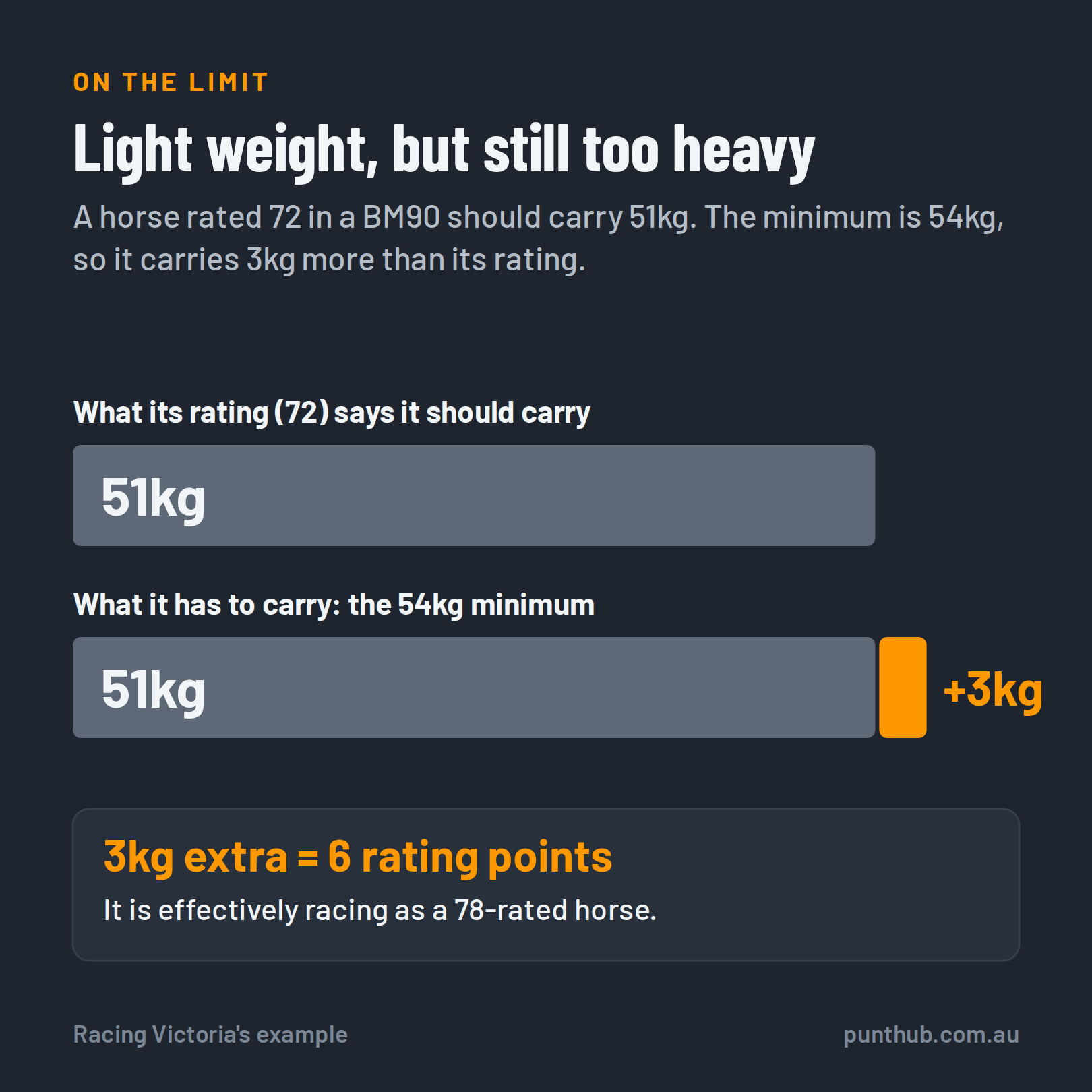
On a form guide, you'll often see this described as a horse being "on the limit" or "out of the handicap". It's racing above its class, and the weight tells you so.
The big handicaps: the Cups
The big Spring handicaps work the same way, with a few differences. For the Caulfield Cup and Melbourne Cup, the handicapper starts with the top weight and works down to the minimum, which is 51kg (49kg for three-year-olds). The top weight must be at least 59kg.
The other big difference is penalties. Weights for the Cups come out in September, weeks before the races. If a horse then wins a qualifying race in between, the handicapper can add weight to it.
The perfect example is Half Yours in 2025:
When the weights came out, he was on the 51kg limit for both Cups.
He won the Naturalism and picked up a 1.5kg penalty for the Caulfield Cup.
He won the Caulfield Cup, and the handicapper added 2kg for the Melbourne Cup, taking him to 53kg.
He won the Melbourne Cup carrying 53kg.
When the 2026 Melbourne Cup weights came out, he was top weight on 59kg: 6kg more than he carried to win it. According to the handicapper, the last horse to win carrying 59kg or more was Rain Lover in 1969.
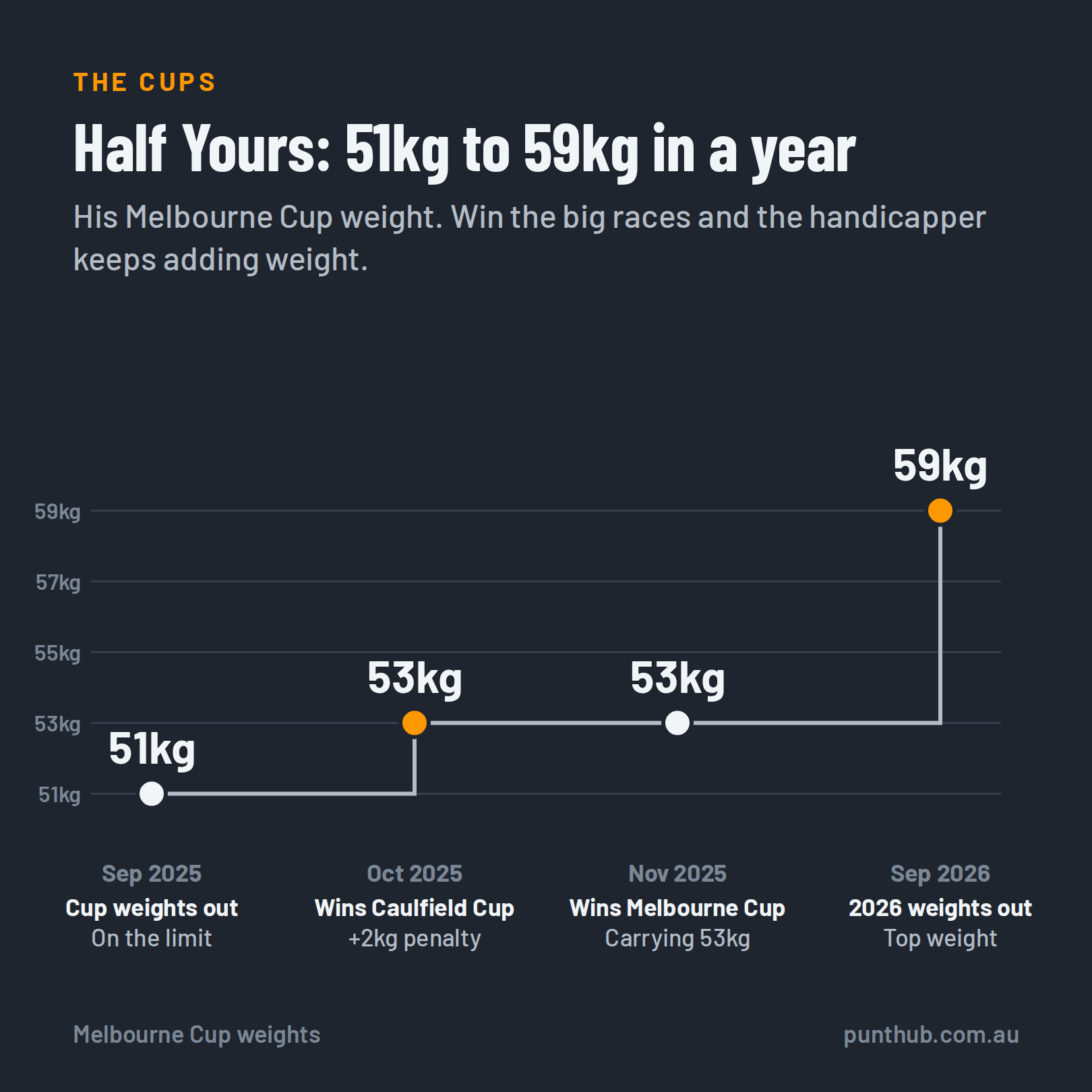
That's handicapping in action. Win, and the weight keeps coming until the horse finds its level.
Races where ratings matter less
Weight-for-age (WFA): weights are set by a national scale based on age, sex, distance and the time of year. The Cox Plate is the famous one. There's no handicap, so the best horse usually has the edge.
Set weights: every horse carries the same weight, less 2kg for fillies and mares. The Golden Slipper is one.
Set weights and penalties (SWP): a set weight, plus extra for horses that have won certain races.
Our guide to racing codes and race types covers these in more detail.
Apprentice claims
Apprentice jockeys can claim weight off the horse's allotted weight while they learn:
3kg until they've ridden 20 winners
2kg until 50 winners
1.5kg until 80 winners
In city races, only city wins count towards those numbers. In provincial races, city and provincial wins count, and in country races every win counts. Claims aren't allowed in Group or Listed races.
Here's the useful bit: a 3kg claim is worth 6 rating points. The handicappers also ignore the claim when they re-rate the horse afterwards, so a horse that wins with a 3kg claim is rated as if it carried the full weight. Next time, without the claim, it can find things much tougher.
How handicapping helps your betting
Weight isn't everything. Plenty of horses win under big weights, and there's no official rule that converts kilos into lengths. But understanding the ratings helps you see a race the way the handicapper sees it, and then spot where they might be wrong.
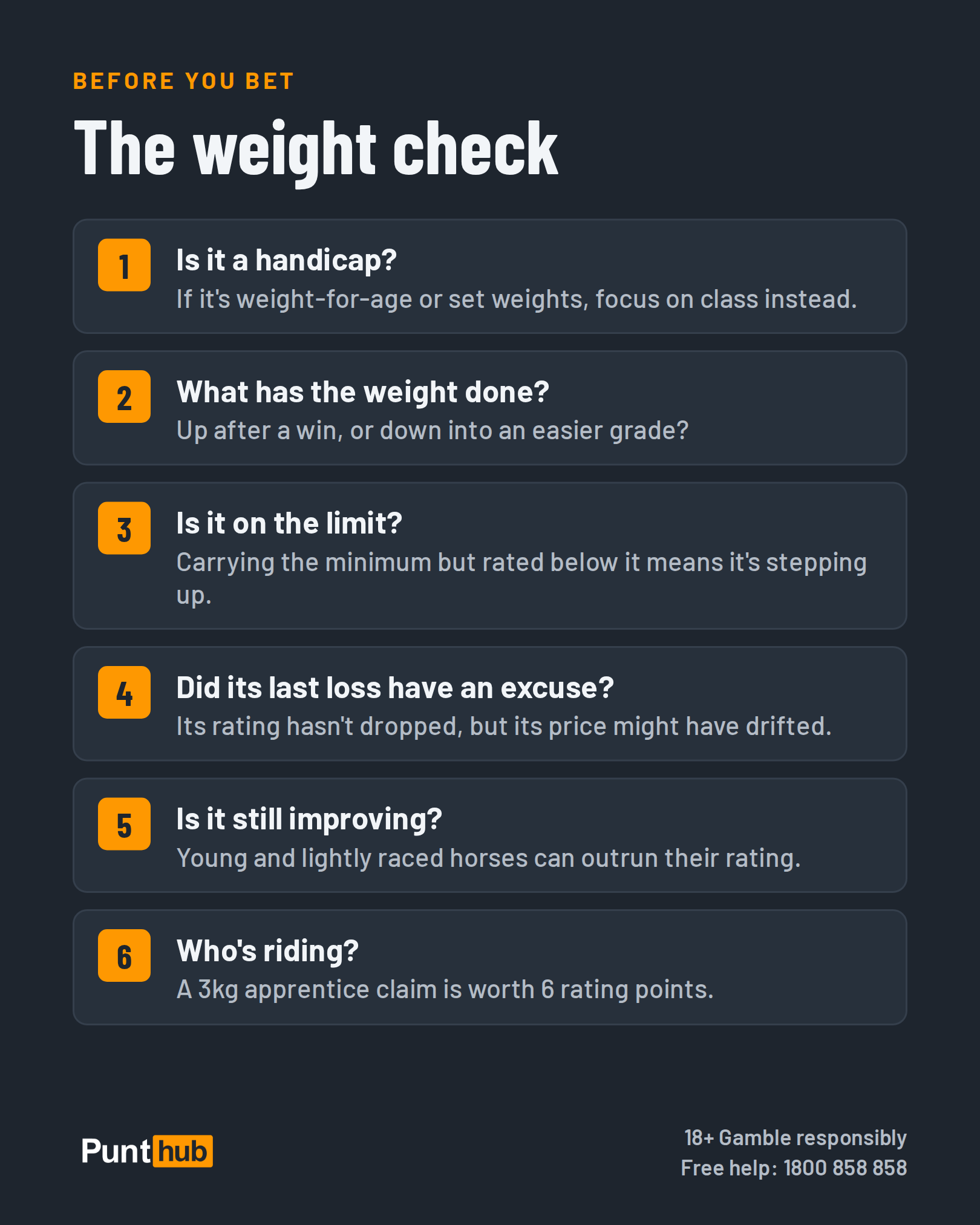
1. Read weight as a change, not a number
60kg on its own tells you very little. What matters is the change. A horse going up 3kg after a win is meeting the same rivals on worse terms. A horse coming down in weight, or dropping into an easier benchmark, is getting a better go.
2. Be careful with last-start winners
A win usually adds 3 to 7 points. The winner now has to do it again with 1.5kg to 3.5kg more on its back, often against better horses. Last-start winners are popular, so their prices are often short for a horse that's just been made harder to win with.
3. Look for unlucky losers
Ratings don't drop after a loss with a valid excuse. A horse that was held up, caught wide or ran the wrong trip keeps its rating, but its form line looks bad. Punters skim it and move on, so the price can drift. If you've watched the replay and the excuse is real, that's where value hides.
4. Watch for horses slipping down the ratings
Ratings drop slowly, usually 0.5kg to 1kg at a time after genuinely poor runs. After a few of those, a horse that used to be competitive can end up on a much lighter weight in an easier race. If its last runs had reasons (a long break, the wrong track), it could be well placed now.
5. Treat "on the limit" horses with caution
A horse carrying the minimum weight but rated well below it is carrying more than it should. Light weights look attractive on a form guide, but here the horse is actually stepping up in class.
6. Back improvers before the handicapper catches up
Ratings are based on what a horse has already done. Lightly raced horses, three-year-olds, and horses with a new trainer, new gear or a step up in distance can improve faster than their ratings. A horse that keeps winning and keeps rising has to keep improving to cope with the extra weight, and young horses often do.
7. Factor in the claim
A good apprentice with a 3kg claim on a highly weighted horse takes 6 rating points off it. Before you write off a top weight, check who's riding.
8. In WFA races, worry less about the weights
Weight-for-age and set-weight races aren't handicaps. There, focus on class: the highest-rated horse is usually the one to beat.
Put it all together with the live fields and race schedules, check the live odds and market movers, and for how prices themselves work, read our guide to horse racing betting strategies.
Quick glossary
Rating: the handicappers' number for how good a horse is.
Benchmark (BM): the rating a handicap race is built around. In a BM78, a horse rated 78 carries 60kg.
Top weight: the horse carrying the most weight in the race.
Minimum weight, or the limit: the lightest weight allowed, usually 54kg.
True weight: what a horse would carry if there were no minimum.
Out of the handicap: a horse whose true weight is below the minimum, so it carries more than its rating suggests.
Penalty: extra weight added after a horse wins once weights have been released.
Claim: weight an apprentice jockey takes off the horse's allotted weight.
Overweight: when a jockey can't make the allotted weight and the horse carries more.
Responsible gambling
Knowing how handicapping works can make you a sharper punter, but it doesn't change the maths: over time, the margin in every price favours the operator. Set deposit limits before you start, bet only what you can afford to lose, and never chase losses. BetStop lets you self-exclude from every licensed Australian online wagering operator. Free, confidential help is on 1800 858 858 or at gamblinghelponline.org.au, and our responsible gambling resources have more.
Frequently asked questions
Who sets the weights in Victorian races?
Racing Victoria's handicapping panel. It gives every horse a rating and reviews it after each run. In handicap races, weights are worked out from those ratings.
How much weight is one rating point?
Half a kilo. A horse rated 10 points higher than another carries 5kg more in a handicap.
What does BM70 mean?
It's a benchmark 70 handicap. A horse rated 70 carries 60kg, and every point either side moves the weight by 0.5kg, down to the minimum weight.
Does a horse's rating go down when it loses?
Not automatically. Ratings only drop after genuinely poor runs, usually by 0.5kg to 1kg at a time, and not at all if the horse had a valid excuse.
What does "on the limit" mean?
It means the horse is carrying the minimum weight even though its rating says it should carry less. It's effectively racing above its rating.
Why do Melbourne Cup horses get penalties?
Weights are released weeks before the race. If a horse wins a qualifying race in the meantime, the handicapper can add weight so it isn't better off than its new form says.
Does an apprentice claim help?
It can. A 3kg claim is worth 6 rating points. But claims aren't allowed in Group or Listed races, and you're trading weight for experience.
More answers in our help and FAQ.
Disclaimer: General information only, not betting advice. Handicapping rules, minimum weights and claims can change, so check the official race conditions. Punt Hub is not a bookmaker. Chances are you're about to lose. Free, confidential support: 1800 858 858.
18+ only. Gamble responsibly.