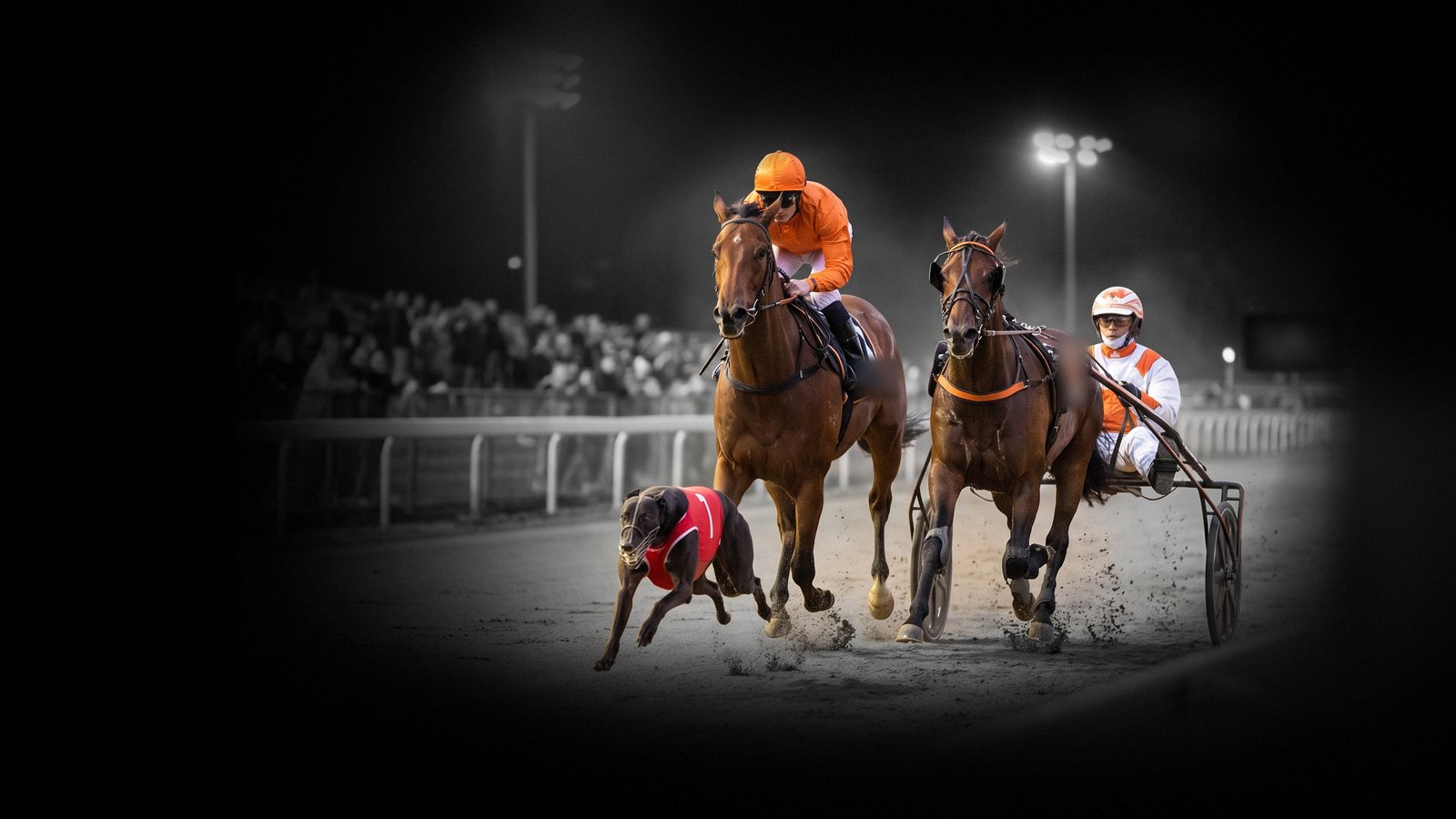
The short version: Australia races three codes. There are thoroughbreds (the gallops), harness (the trots) and greyhounds (the dogs). Each one has its own way of starting a race, sorting runners by ability and writing up form. If you can read the race type, you know who's allowed in, how the weights or starts are set, and what a form line is actually telling you.
This guide covers the codes, the race types you'll see on every racecard, and the numbers that matter in each.
General information only, not advice. There are no guaranteed winners and every bet is a risk. 18+ only.
Key takeaways
Race type tells you the class of the field. A maiden and a Group 1 are different worlds.
Thoroughbreds are sorted by wins, ratings or prestige. Weights are set by handicap, set weights or weight-for-age.
Harness horses are sorted by ratings. They start from a moving barrier or a standing start, and mile rate is the key time figure.
Greyhounds are sorted by grade. Above a certain level, the grade can depend on the track and distance.
The three codes at a glance
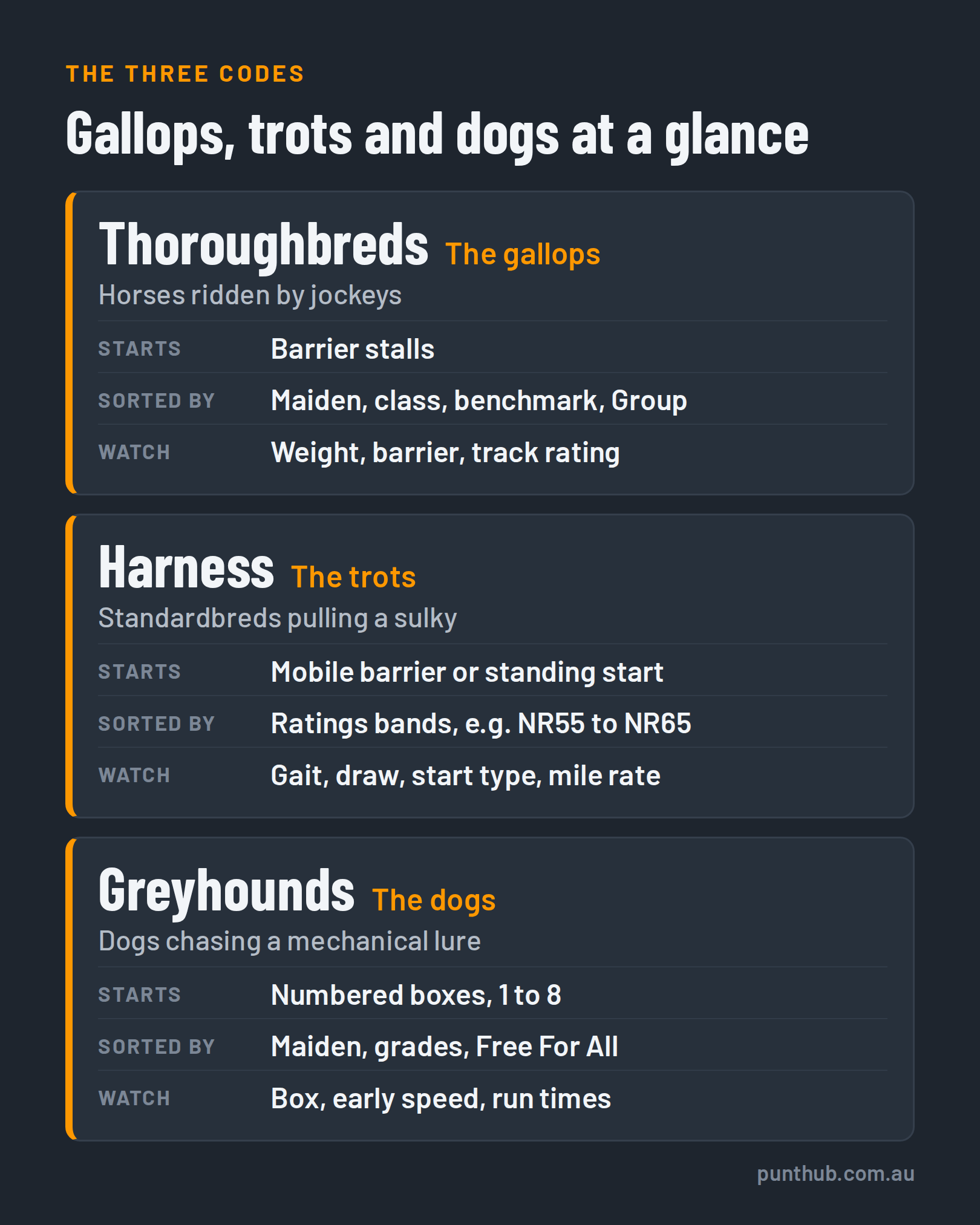
Thoroughbreds: horses ridden by jockeys, starting from barrier stalls. Races are sorted into maiden, class, benchmark, Group and Listed. Watch the weight, the barrier and the track rating.
Harness: Standardbreds pulling a sulky, steered by a driver, starting behind a mobile barrier or from a standing start. Races are framed in ratings bands. Watch the gait, the draw, the start type and the mile rate.
Greyhounds: dogs chasing a mechanical lure from numbered boxes. Races run from maidens up through the grades to Free For Alls. Watch the box, early speed and run times.
Many betting apps and form guides use R, H and G (or an icon) for the gallops, harness and greyhounds. The meeting name usually gives it away too.
Thoroughbreds: the gallops
Thoroughbred racing is the biggest code in the country. It runs from Tuesday country meetings to the Melbourne Cup. Flat races go from about 800m sprints up to 3,200m cups, mostly on turf, with some meetings on synthetic tracks. Jumps races are longer.
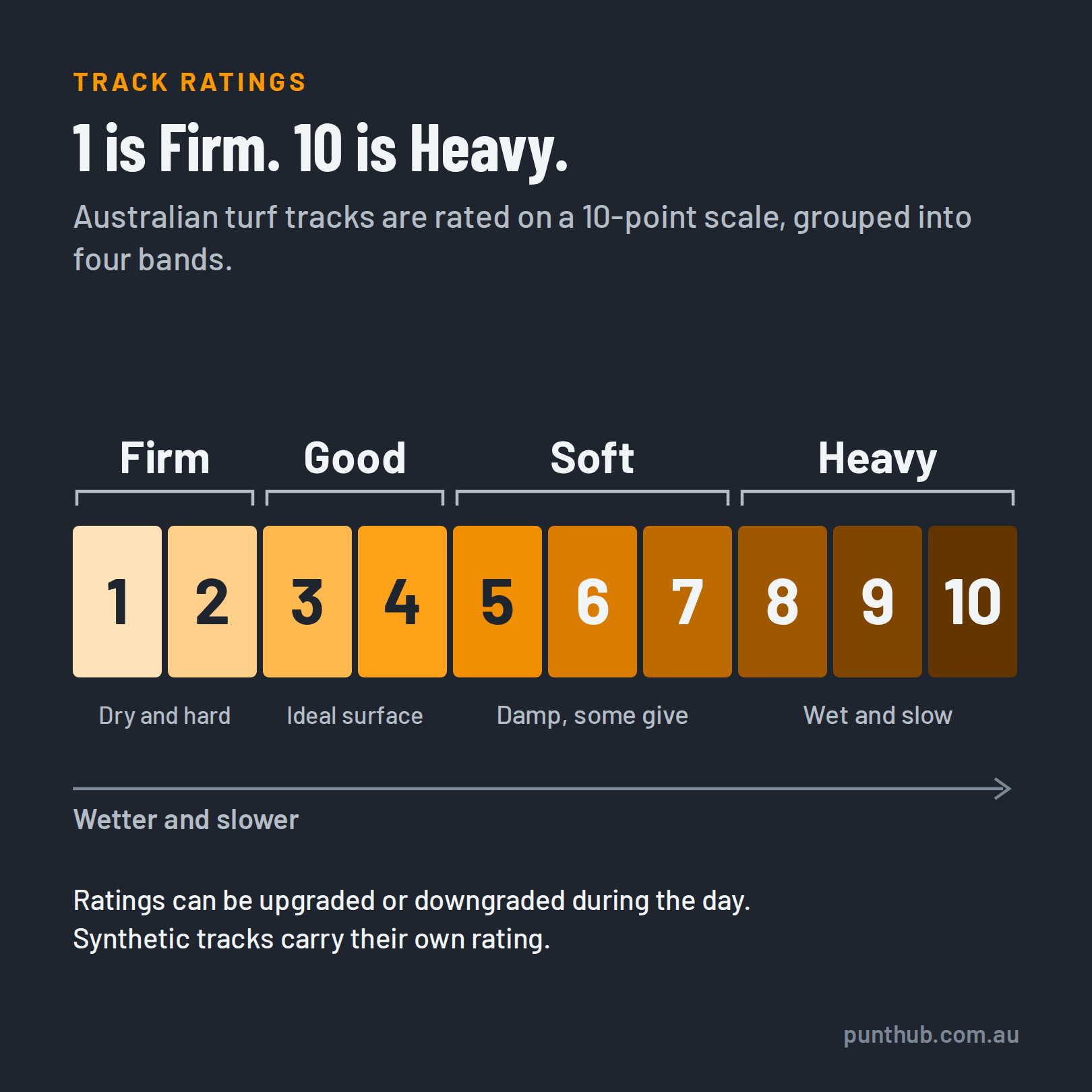
Turf tracks are rated from 1 to 10: Firm (1 to 2), Good (3 to 4), Soft (5 to 7) and Heavy (8 to 10). The rating can be upgraded or downgraded during the day as the track dries out or rain comes in. Synthetic tracks carry their own rating.
Jumps racing, over hurdles and steeplechase fences, now runs only in Victoria. South Australia banned it by law in 2022.
Maiden, class and benchmark races
Maiden: for horses that haven't won a race yet. One win and they're out.
Class races: capped by wins. Under the Racing NSW rules, a Class 1 race is for horses that haven't won more than one race on the flat. Class 2 allows two wins, and so on up the ladder.
Benchmark (BM): every horse carries a rating, and the weights are set from that rating. The number in the race name is the benchmark.
How a benchmark race sets weights: in Victoria, a horse carries 0.5kg for every rating point. Racing Victoria's example is a BM90. A horse rated 90 carries 60kg, and the weights drop 0.5kg per point down to the 54kg minimum for a horse rated 78. So a horse rated 80 in that race carries 55kg, and anything rated below 78 still carries 54kg. Victorian benchmark races have no upper rating limit, and each point above the benchmark adds another 0.5kg. Other states write their own conditions, so read the race conditions on the card.
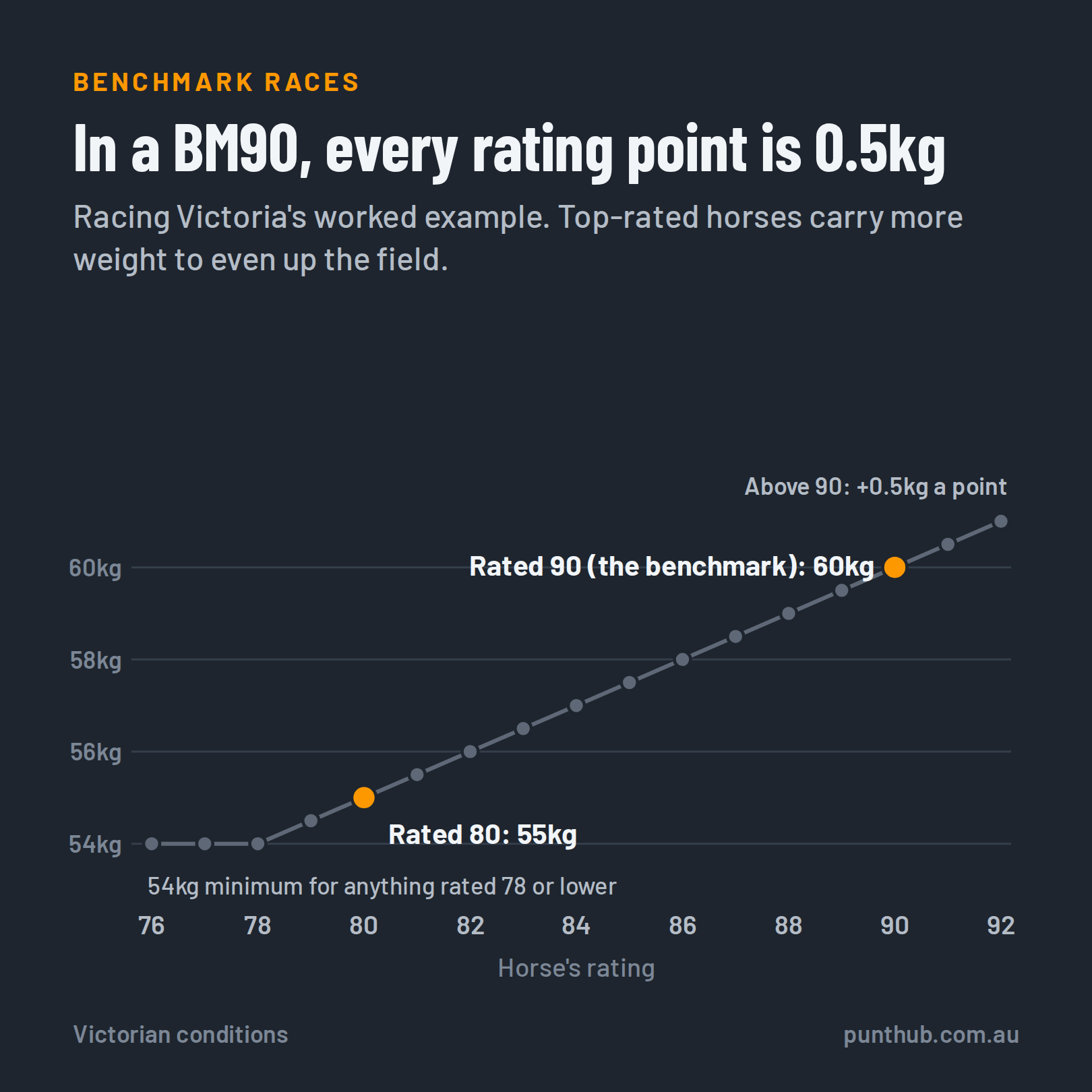
Why it matters: a horse rated at the bottom of a BM race gets a big weight break, but it's there because it's rated lower. Ratings move after runs, so the same horse can be well weighted one start and harshly weighted the next.
How the weights are set
Handicap: the handicapper gives the better horses more weight to even up the field. The Melbourne Cup and the Doncaster Mile are both Group 1 handicaps.
Set weights: weights depend only on age and sex, not on ability. The Golden Slipper is a set-weights race for two-year-olds.
Weight-for-age (WFA): a national scale sets weights by age, sex, distance and time of year. Younger horses get a weight allowance that shrinks as they mature. The Cox Plate is the best-known WFA race, which is why it's often called a true championship.
Set weights and penalties (SWP): set weights, plus extra weight for horses that have won certain races.
Apprentice jockeys can also claim weight off their horse, usually up to 3kg. The claim drops as they ride more winners: typically 3kg until 20 wins, 2kg until 50 and 1.5kg until 80. In city races only city wins count towards that tally, and claims aren't allowed in Group and Listed races. Look for the claim next to the rider's name.
Group and Listed races
These are the "black-type" races, and they sit at the top of the ladder:
Group 1: the highest level in Australian racing, such as the Melbourne Cup, Cox Plate and Golden Slipper.
Group 2 and Group 3: strong races just below the top level, including many lead-ups to the big races.
Listed: black type below Group level, usually feature races at major meetings.
A race's status isn't permanent. It's reviewed each year against the quality of its fields, and races can be upgraded or downgraded. For 2026-27, that review was run by the Asian Racing Federation's pattern committee, which took the job over from Australia's own committee. A Group 1 can be a WFA race, a set-weights race or a handicap. The status tells you the class of the race, and the weight conditions tell you how it's framed.
Harness: the trots
Harness horses are Standardbreds pulling a lightweight two-wheeled cart called a sulky, with a driver sitting in it. There are two gaits:
Pacers move the legs on the same side together, and wear hopples (straps that help them hold the gait). The large majority of Australian harness races are for pacers.
Trotters, also called squaregaiters, move diagonal legs together. They usually race in trotters-only events.
A horse that breaks into a gallop has to be steadied back to its gait. Stewards can penalise a horse that gains ground while galloping.
Starts, draws and ratings
Mobile start: the field lines up in two rows behind a moving car with folding wings and is released at speed. The back row starts behind the front row, so inside front-row draws are prized.
Standing start: horses start from a standstill, and handicaps push the better ones back in metres. Under the national handicapping rules, horses start 10m further back for every 5 rating points, so an NR50 starts off the front and an NR55 off 10m (Racing Queensland has a worked guide).
Ratings: under Australian ratings-based handicapping, every horse gets an automatic numeric rating after each run, based on where it finished and the prizemoney on offer. Races are framed in rating bands, such as NR55 to NR65.
Mile rate: the harness number to learn
Mile rate converts a run into the time it would take to cover a mile (about 1,609m) at the same pace, so you can compare runs over different distances. A mile rate of 1:56.3 means one minute 56.3 seconds per mile, and lower is faster. Context still matters: a fast mile rate from a horse that led with an easy run isn't the same as one from a horse that sat three wide with no cover.
Greyhounds: the dogs
Greyhound races usually have eight dogs jumping from numbered boxes after a lure. Box 1 is on the inside rail and box 8 is on the outside. Each runner's rug colour matches its box number:
Box 1: red
Box 2: black and white stripes
Box 3: white
Box 4: blue
Box 5: yellow
Box 6: green
Box 7: black
Box 8: pink
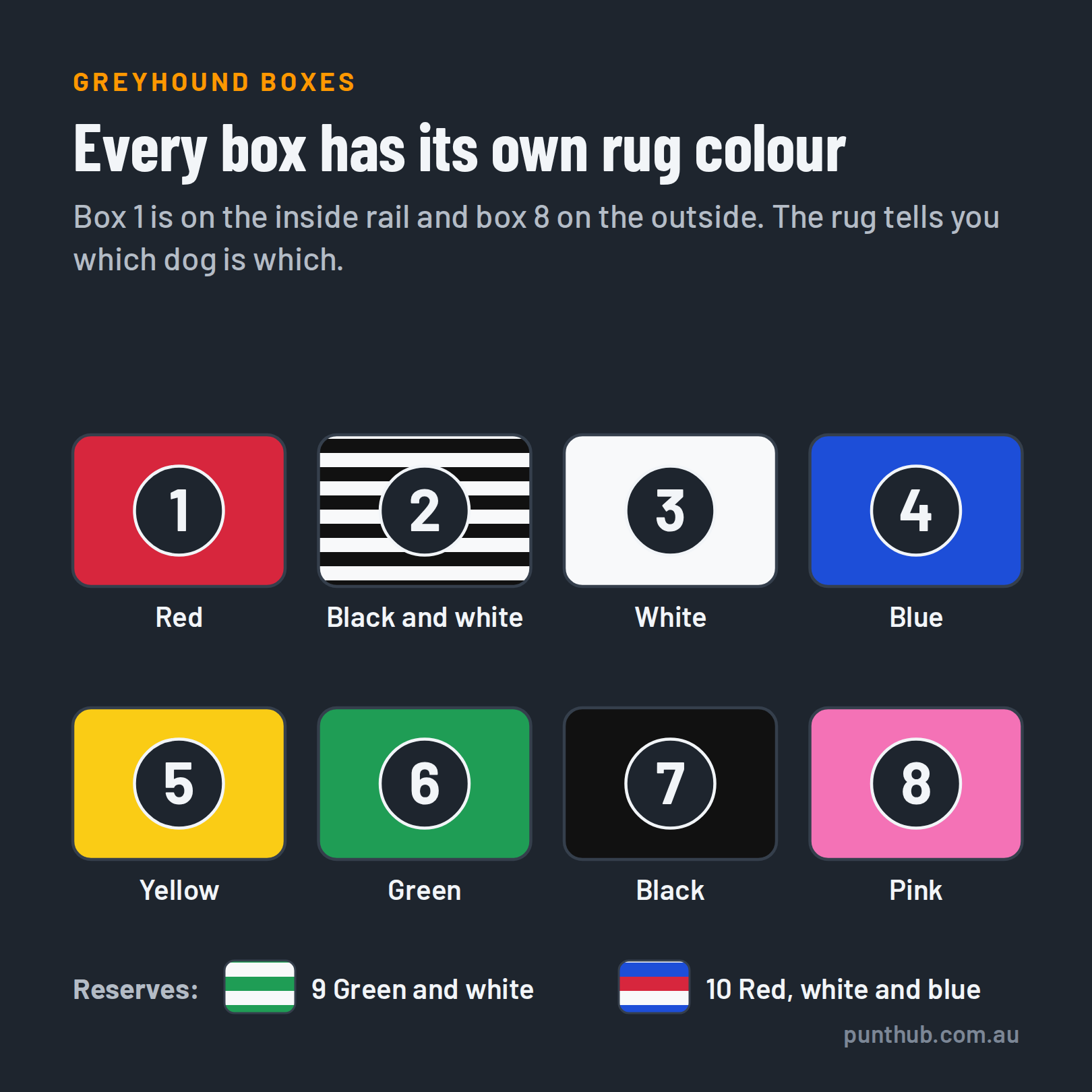
Reserves wear 9 (green and white stripes) and 10 (red, white and blue). They keep their own numbers when they fill a box left empty by a scratching.
Grades, boxes and distances
Grades: states run their own systems. Under the Victorian guidelines, a maiden that wins goes to Grade 7, then Grade 6 and Grade 5 with each further win, and those grades apply at every track. From Grade 5 up, a dog only moves up a grade at the track and distance where it won. Free For All races are for dogs graded 4 to 1. A higher number means a lower class.
Box draws: these are normally random. NSW has trialled preferred box draws in selected races, where dogs are placed by running style: railers inside, straight runners in the middle and wide runners outside.
Distances: categories vary by state. Queensland's grading treats 441m to 530m as sprint, 531m to 640m as middle distance and 641m and up as staying.
Early speed is the big one in the dogs. A dog that can lead from box 1 avoids most of the trouble at the first turn.
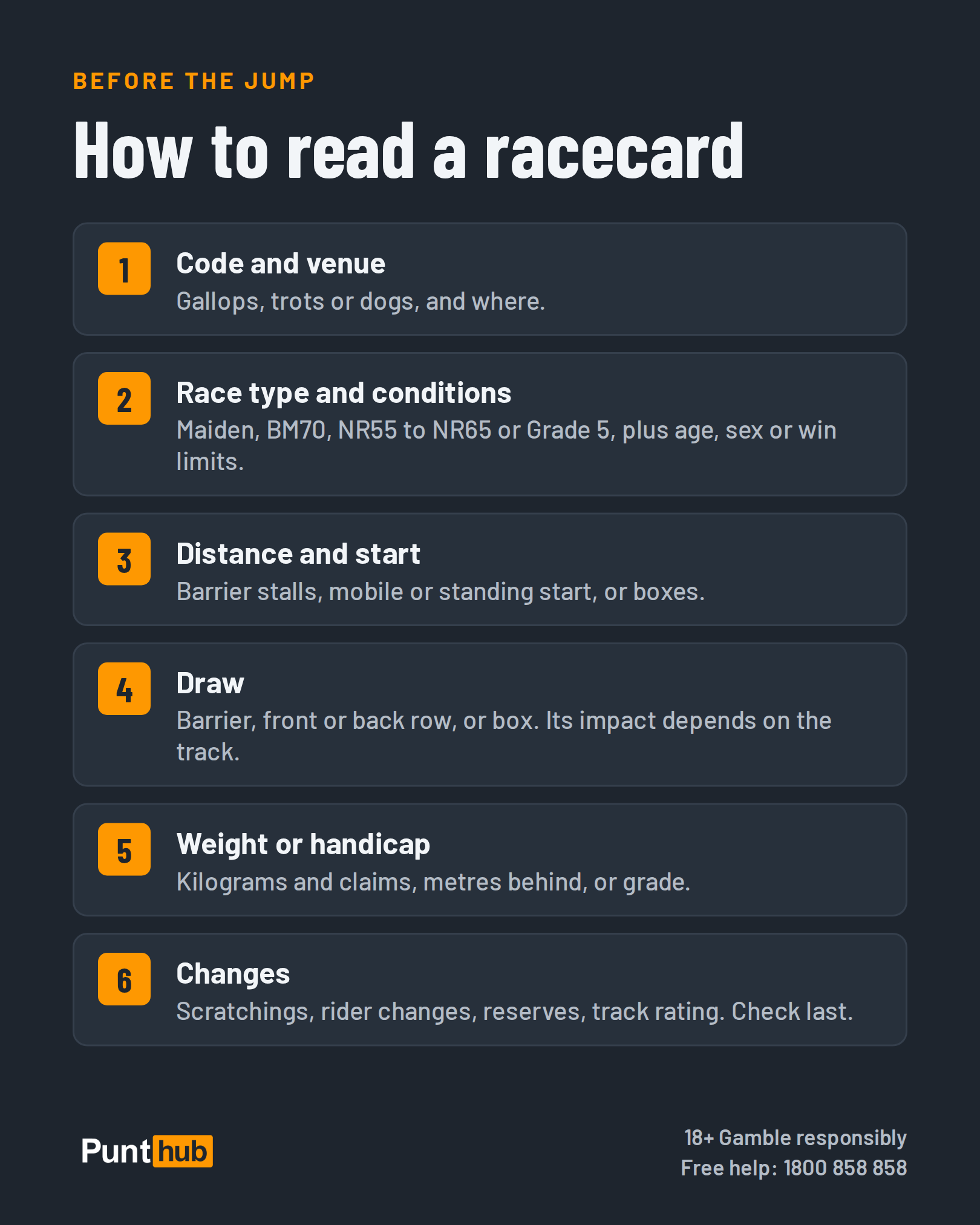
How to read a racecard
Code and venue: are you looking at the gallops, the trots or the dogs, and where?
Race type and conditions: maiden, BM70, NR55 to NR65 or Grade 5, plus any age, sex or win restrictions.
Distance and start: barrier stalls, mobile or standing start, or boxes.
Draw: barrier, front or back row, or box number. Its impact depends on the track and distance.
Weight or handicap: kilograms and apprentice claims for gallopers, metres behind for standing-start harness horses, and grade for dogs.
Changes: scratchings, rider or driver changes, reserves and track rating updates. Check these last, right before the race.
Line it all up with live Australian racing fields, odds and race schedules. For what the odds themselves mean, read our guide to horse racing betting strategies, and keep an eye on the live odds and market movers. If you're comparing fixed odds with the tote, our guide to fixed odds vs tote betting breaks down how each one pays.
Responsible gambling
Racing is entertainment, not income. Set deposit and time limits before you start, and stop when it stops being fun. BetStop lets you self-exclude from every licensed Australian online wagering operator. Free, confidential help is available on 1800 858 858 or at gamblinghelponline.org.au. See our responsible gambling resources and support.
Frequently asked questions
What are the three Australian racing codes?
Thoroughbreds (horses ridden by jockeys), harness (Standardbreds pulling a sulky, steered by a driver) and greyhounds (dogs chasing a lure from numbered boxes).
What is a benchmark race?
A handicap where weights are set from each horse's rating. In Victoria, each rating point is worth 0.5kg. In a BM90, a 90-rated horse carries 60kg and a 78-rated horse carries the 54kg minimum.
What's the difference between a handicap, set weights and weight-for-age?
A handicap gives better horses more weight. Set weights depend only on age and sex. Weight-for-age uses a national scale based on age, sex, distance and time of year.
What does Group 1 mean?
It's the highest level of Australian thoroughbred racing, above Group 2, Group 3 and Listed races. Race status is reviewed each year and can change.
What do track ratings mean?
Turf tracks are rated from 1 to 10: Firm (1 to 2), Good (3 to 4), Soft (5 to 7) and Heavy (8 to 10). The higher the number, the wetter and slower the track.
What's the difference between pacers and trotters?
Pacers move same-side legs together and wear hopples. Trotters move diagonal legs together. The large majority of Australian harness races are for pacers.
What is mile rate in harness racing?
It's a run's pace expressed as the time per mile, so runs over different distances can be compared. Lower is faster.
Are greyhound grades the same in every state?
No. Each state sets its own grading rules, and in Victoria, grades from Grade 5 up are specific to the track and distance.
More answers in the punter help and FAQ.
Disclaimer: General information only, not advice. Punt Hub is not a bookmaker and does not accept bets. Racing rules, grading and conditions vary by state and change over time, so check official race conditions. No outcome is guaranteed. Free, confidential support: 1800 858 858.
18+ only. Gamble responsibly.